TL;DR
- Use a one-page resume for most college applications, internships, and entry-level jobs.
- Put education near the top if you are still in school or recently graduated.
- Use reverse-chronological order within sections, with the most recent experience first.
- Include projects, coursework, campus leadership, volunteer work, and part-time jobs when they show relevant skills.
- Use standard headings and clean formatting so the resume is ATS-friendly.
- Tailor the resume for each internship or job instead of using one generic version.
Table of Contents
The Best Resume Format for College Students
For most college students, the best resume format is a one-page reverse-chronological resume. That means your most recent education, experience, projects, and activities appear first within each section.
This format works because it is familiar to recruiters, easy to skim, and friendly to applicant tracking systems. It also helps you organize different types of student experience without making the resume look scattered.
University career centers often recommend this structure. USC's Career Center describes the one-page reverse chronological resume as the most acceptable and readily used format for college students. UC Davis also notes that recent graduates typically use one page, with two pages only when there is extensive work history.
Why reverse-chronological works
- Recruiters can quickly see what you are doing now.
- Your current school, major, and graduation timeline are easy to find.
- Internships, projects, part-time jobs, and leadership roles can all fit cleanly.
- ATS software can parse standard headings and dates more easily.
A functional resume that hides dates or groups everything by skill is usually not the best choice for students. It can make your background harder to verify and may look like you are trying to hide a lack of experience. A hybrid student resume can work, but it should still keep dates, organizations, and roles clear.
Recommended Student Resume Sections
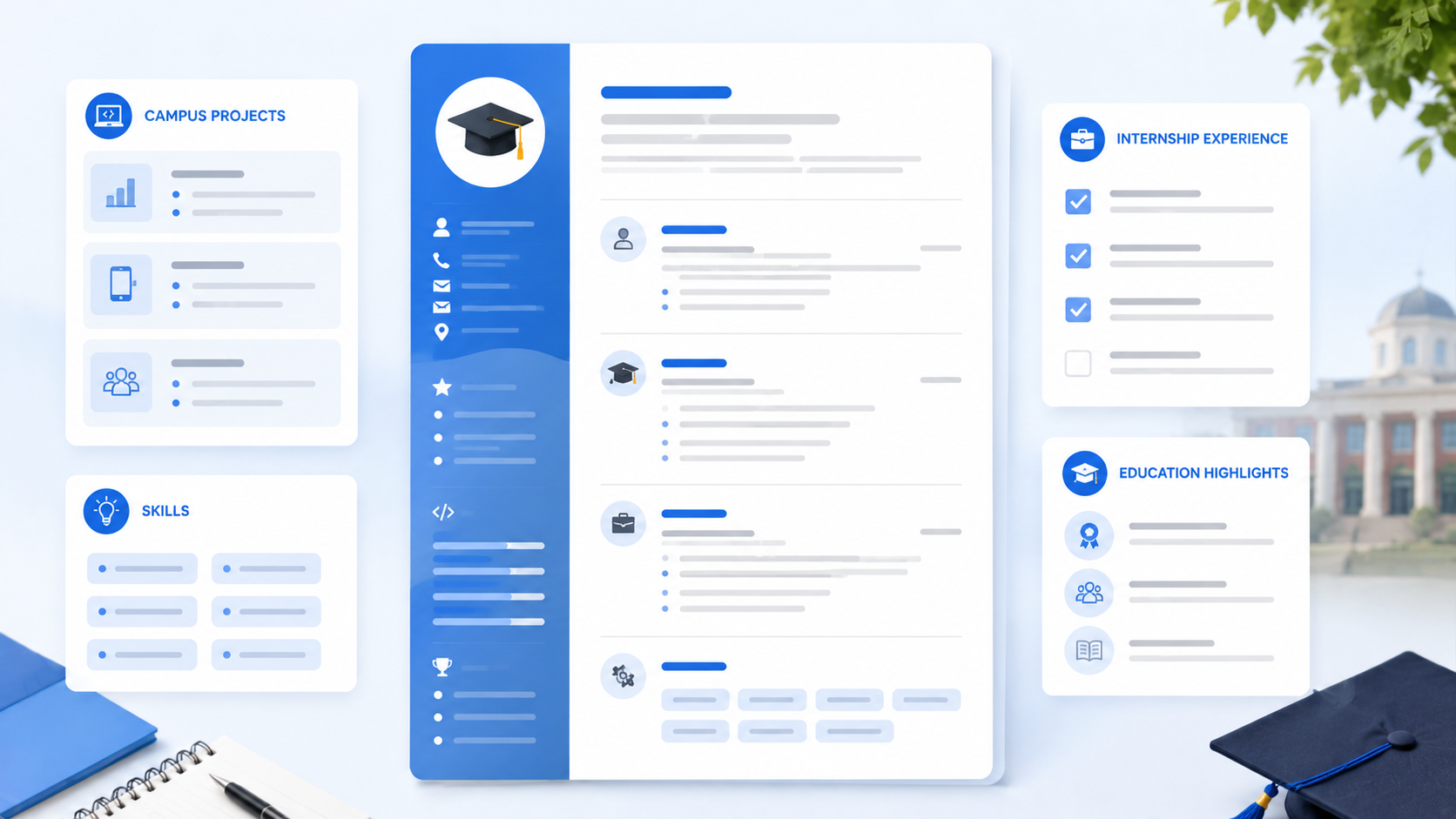
Your exact section order depends on the job. A computer science student applying for a software internship may put technical skills and projects higher. A business student applying for a marketing internship may lead with education, experience, and campaign projects.
Best general section order
- Contact information
- Resume summary or headline
- Education
- Relevant experience
- Projects
- Skills
- Leadership, activities, awards, or volunteer work
If you have a strong internship, put Relevant Experience before Projects. If you do not have formal experience yet, put Projects before Experience and include volunteer or campus work.
Contact information
Include your name, city and state, phone number, professional email, LinkedIn URL, and portfolio or GitHub link if relevant. Do not include your full street address. Do not use a school email if you may lose access after graduation.
Resume summary
A student resume summary should be short. Mention your major, target role, top skills, and one proof point.
Example: Marketing student seeking a summer internship, with experience creating social media content, researching competitors, and building campaign reports in Google Sheets.
How to Format Education
Education usually belongs near the top of a college student resume because it is one of your strongest qualifications. Format it clearly and include details that support the job.
Basic education format
University of Florida - Gainesville, FL
Bachelor of Science in Business Administration, Expected May 2027
You can add:
- Major and minor
- Expected graduation date
- Relevant coursework
- GPA if strong, usually 3.5 or higher
- Honors, scholarships, or Dean's List
- Study abroad if relevant
Relevant coursework example
Relevant coursework: Financial Accounting, Business Analytics, Professional Communication, Marketing Research
Only list coursework that helps your target role. If you are applying for data analyst internships, list statistics, SQL, analytics, programming, economics, or research methods. If you are applying for HR roles, list organizational behavior, labor relations, communication, or psychology courses.
Should high school be included?
First-year college students may include high school achievements if they are still relevant. By sophomore or junior year, remove most high school details and replace them with college experience. If a high school award is nationally recognized or directly tied to your target role, it can stay longer.
How to Format Experience Without Much Work History
College students often assume experience means paid professional work. It does not. Experience can include internships, campus jobs, part-time work, volunteer service, research assistant roles, tutoring, club leadership, athletics, and event coordination.
The key is to describe the experience in a way that connects to the role.
Part-time job example
Customer Service Associate - Target, Austin, TX
August 2025 - Present
- Assisted 60+ customers per shift with product questions, returns, and checkout issues in a high-volume retail environment.
- Processed POS transactions accurately and helped train two new team members on closing procedures.
- Maintained organized merchandise displays and flagged low-stock items to department leads.
This works for many roles because it shows communication, accuracy, customer service, reliability, and teamwork.
Campus leadership example
Events Committee Member - Business Student Association
September 2025 - May 2026
- Coordinated room reservations, attendance tracking, and reminder emails for monthly networking events with 40-70 students.
- Prepared speaker research notes and shared event recaps with the executive board after each session.
Campus leadership can be strong evidence when you make the responsibilities specific.
How to List Projects on a College Resume
Projects are one of the most valuable sections for college students. They show skills before you have years of work history. Projects can come from class assignments, labs, capstone courses, research, hackathons, portfolio work, volunteer work, or personal learning.
What to include in a project bullet
- The problem or assignment
- Your role
- Tools, methods, or software used
- Output or result
- Team size, audience, or scope when relevant
Data project example
Sales Trend Analysis Project - Business Analytics Course
- Analyzed a 1,500-row sales dataset in Excel using pivot tables, filters, and charts to identify seasonal revenue patterns.
- Presented findings in a 10-slide report with recommendations for inventory planning and promotional timing.
Software project example
Task Tracker Web App - Personal Project
- Built a responsive task management app using HTML, CSS, JavaScript, and local storage.
- Added task filtering, completion status, and form validation; documented code updates in GitHub.
How to Format Skills
Your skills section should be targeted. Do not list every skill you can think of. Choose skills that match the job description and that you can discuss in an interview.
Good student skills sections
Business internship: Microsoft Excel, Google Sheets, data entry, market research, presentation writing, Canva, customer service
Software internship: Python, JavaScript, Java, Git, GitHub, SQL, HTML, CSS, data structures
Healthcare administration: scheduling, patient communication, Microsoft Office, documentation, HIPAA awareness, customer service
Marketing internship: social media scheduling, Canva, Google Analytics, content writing, competitor research, email marketing
Support soft skills with evidence
NACE's Job Outlook 2025 survey found that employers reviewing college student resumes place high value on problem-solving and teamwork. Do not only list those words. Show them in bullets.
Weak: Teamwork, problem-solving, communication.
Better: Collaborated with a four-person team to research competitor pricing, summarize survey responses, and present recommendations to faculty panel.
College Student Resume Examples
Example 1: First-year student applying for campus job
Recommended order: Contact, Summary, Education, Skills, Volunteer Experience, Activities
Because the student may not have much college experience yet, high school leadership or volunteer work can still be included if relevant.
Example 2: Junior applying for marketing internship
Recommended order: Contact, Summary, Education, Relevant Experience, Projects, Skills, Activities
The student should highlight campaign projects, content tools, research, writing samples, and any customer-facing experience.
Example 3: Computer science student applying for software internship
Recommended order: Contact, Education, Technical Skills, Projects, Experience, Activities
Technical skills and projects should be high because employers need to see languages, frameworks, and evidence of building.
Example 4: Senior applying for entry-level analyst role
Recommended order: Contact, Summary, Education, Projects, Experience, Skills, Certifications
Data projects, Excel, SQL, Tableau, Python, statistics coursework, and internships should appear before unrelated part-time work.
ATS-Friendly Formatting Tips for Student Resumes
Many internships and entry-level jobs use online application systems. Your resume should be easy for applicant tracking systems to parse and easy for recruiters to read.
Use standard headings
- Education
- Experience
- Projects
- Skills
- Certifications
- Leadership
Avoid formatting that can break parsing
- Text boxes
- Scanned PDFs
- Important text inside images
- Complex tables
- Unusual section names
- Skill charts or rating bars
Use a clean PDF unless the employer asks for Word. Make sure your text is selectable in the PDF.
College Resume Mistakes to Avoid
Making the resume too long
Most college students should keep the resume to one page. If you need two pages, make sure the second page contains relevant internships, research, publications, or technical projects, not filler.
Using a generic objective
Replace "seeking an opportunity to grow" with a short summary that names your target role and relevant skills.
Listing coursework without strategy
Relevant coursework should support the job. Do not list every class.
Ignoring part-time work
Retail, food service, tutoring, childcare, and campus jobs can show responsibility, communication, teamwork, and time management.
Forgetting to tailor
Your resume for a finance internship should not be identical to your resume for a student assistant job. Adjust your summary, skills, and project order.
Student Resume Checklist
- One page for most student applications
- Education near the top
- Professional email and working links
- Relevant coursework only
- Projects that show tools and outcomes
- Experience bullets with action verbs
- Skills matched to the job description
- Clean, ATS-friendly layout
- No references listed on the resume
- Proofread before applying
How AICV Create Helps College Students Build Better Resumes
AICV Create helps college students turn classes, projects, part-time jobs, and activities into a polished resume. You can build an ATS-friendly layout, improve bullet points, choose stronger wording, and export a professional PDF.
This is especially helpful when you are applying for internships or your first full-time role and are not sure what counts as experience. AICV Create helps you organize the proof you already have.
FAQ
What is the best resume format for college students?
The best format for most college students is a one-page reverse-chronological resume with education near the top, followed by relevant experience, projects, skills, and activities.
Should college students use a one-page resume?
Yes. Most college students should use one page unless they have substantial relevant experience, publications, or specialized requirements.
Should education go first on a college resume?
Usually yes. Education should go near the top if you are a current student, recent graduate, or applying for internships and entry-level roles.
Can college projects go on a resume?
Yes. Class projects, research, labs, capstone work, and portfolio projects belong on a college resume when they show skills related to the job.
Should high school be on a college resume?
First-year students may include high school achievements if relevant. By sophomore or junior year, most students should replace high school details with college experience.
What skills should college students list?
List skills that match the job, such as software tools, technical skills, communication, research, writing, data analysis, customer service, leadership, and teamwork supported by examples.
Conclusion
The best resume format for college students is clear, focused, and easy to scan. Keep it to one page in most cases. Put education near the top. Use projects, internships, part-time jobs, volunteer work, and activities to prove your skills. Write bullets that show what you did and how it connects to the job.
Your resume does not need to look like a senior professional's resume. It needs to show that you are ready to contribute, learn, and handle responsibility.
If you want to build a student resume faster, AICV Create can help you choose the right sections, improve your wording, and download an ATS-friendly PDF for internships, campus jobs, and entry-level applications.