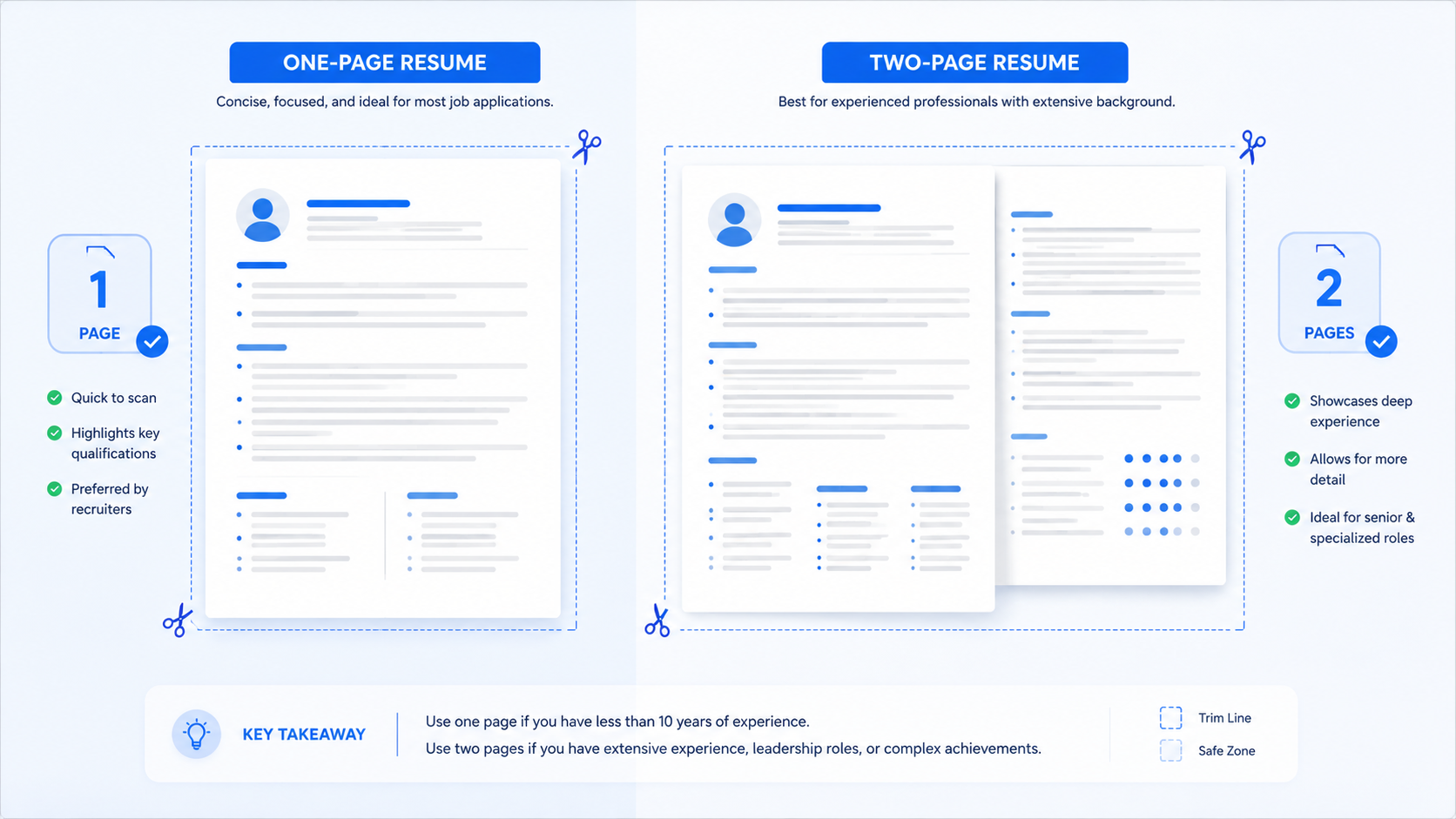
Recruiters do not reward longer resumes. If you are asking how long should a resume be, the answer is simple: use one page when one page proves your fit, and use two pages only when the second page adds strong, relevant proof.
This guide breaks down resume length for students, freshers, career changers, mid-career professionals, and senior applicants. You will learn when a one page resume is best, when two pages are fine, what to cut first, and how to keep your resume easy for both recruiters and ATS systems to read.
TL;DR
- Most students, freshers, and entry-level applicants should use a one page resume.
- Two pages are fine for experienced professionals when every section is relevant.
- Resume length matters less than clarity, proof, and job match.
- Never shrink text or margins just to force content onto one page.
- Cut repeated duties, old jobs, weak summaries, and unrelated details first.
Table of Contents
What Resume Length Really Means in 2026
Resume length is not only page count. It is the amount of space you ask a recruiter to spend on your story. A short resume can still feel long if it is packed with vague duties. A two page resume can feel easy if the information is relevant and well organized.
Think of your resume like a highlight reel. The goal is not to show every minute of the game. The goal is to show the plays that prove you belong in the role.
- One page resume: best for students, freshers, internships, campus jobs, and early-career roles.
- Two page resume: useful for 7+ years of relevant experience, leadership, technical work, or specialized fields.
- Three pages or more: rarely needed for U.S. private-sector jobs unless the employer requests a full CV.
- ATS-friendly resume: can be one or two pages as long as the structure is clean.
How to Choose the Right Resume Length
Step 1: Start with your career level
Use your career stage as the first filter.
If you are a student, recent graduate, or applicant with less than five years of experience, start with one page. If you have years of relevant work, certifications, major projects, and leadership proof, two pages may be the better choice.
Step 2: Match the page count to the job
Keep only details that help the employer understand your fit.
A retail job, office assistant role, or internship usually needs a short resume. A software engineering, project management, healthcare, or senior operations role may need more space for tools, projects, compliance, or results.
If you're a college student weighing this same page-count question, see our guide on the best resume format for college students.
Step 3: Count proof, not tasks
Do not add a second page just to list more duties.
A strong bullet shows action, setting, tool, result, or scale. A weak bullet repeats the job description. Before you add length, ask whether the extra line proves something new.
Free tools like AICV Create can help you turn long notes into cleaner bullets and keep the format stable when you export a PDF.
Step 4: Use a simple resume length test
Check whether the second page earns its place.
| Use one page if... | Use two pages if... |
|---|---|
| You have less than five years of experience. | You have 7+ years of relevant experience. |
| Your projects, education, and skills fit cleanly. | You need space for major projects, leadership, or certifications. |
| The second page would repeat old duties. | The second page adds proof that matches the job. |
| You are applying for internships or entry-level jobs. | You are applying for senior, technical, or specialized roles. |
Step 5: Cut before you compress
Do not solve length problems by making the resume hard to read.
If your one page resume is crowded, remove weak content before shrinking fonts or margins. A packed page looks stressful. A clean page feels more confident.
A crowded page is one of several common resume mistakes that cost interviews, so it's worth checking the full list.
Resume Length Mistakes to Avoid
- Shrinking the font too much: Tiny text makes the resume hard to scan. Keep body text readable and use space with control.
- Keeping every old job: Early jobs may not help if they do not connect to the role. Keep older details short unless they add value.
- Using long summaries: A six-line summary can waste prime space. Keep your opening focused on role, skills, and proof.
- Adding references: Do not write "references available upon request." Employers already know they can ask.
- Making page two weak: A second page should not be a parking lot for leftovers. It should contain strong, relevant details.
Pro Tips for a Cleaner One Page Resume
- Use 3 to 5 bullets per role. Keep the strongest bullets and remove repeated tasks.
- Group similar tools. Put related skills on one line instead of spreading them across several rows.
- Shorten older roles. Use one or two bullets for jobs that are less relevant.
- Move education lower when experience is stronger. Let your best proof take the highest space.
- Use clean margins. Normal margins make the resume easier to read than a crowded page.
★ PRO TIP: If you cannot decide what to cut, compare each line with the job description. If a line does not support the target role, it should be shortened or removed.
AICV Create can help with this because you can revise sections, test ATS-friendly templates, and download a clean PDF once the content fits.
Before and After Resume Length Example
Here is a common problem. A recent graduate has a two-page resume with class projects, part-time work, high school awards, hobbies, and a long objective.
Before: Two pages with a five-line objective, every course taken, three old high school awards, a full paragraph about hobbies, and repeated retail duties.
After: One page with a two-line summary, five relevant skills, two class projects, one part-time job with proof-based bullets, education, and one certification.
The after version works because it removes noise. It does not hide experience. It makes the strongest details easier to see.
For a mid-career applicant, the answer may be different. A project manager with 10 years of experience, certifications, and complex project wins may need two pages. The key is that page two must add useful proof, not filler.
What to Cut When Your Resume Is Too Long
Start with content that adds the least value for the role you want.
- Old school details: Remove high school once college, training, or work experience is stronger.
- Repeated bullets: If two bullets say the same thing, keep the better one.
- Unrelated hobbies: Keep hobbies only when they support the role or show useful traits.
- Weak software lists: Remove tools you cannot use confidently in an interview.
- Long company descriptions: Keep company context short unless the employer would not understand the role without it.
Once you've trimmed the excess, make sure what's left is aimed correctly — see how to match your resume to a job description.
Does Resume Length Matter for ATS?
ATS software does not reject a resume only because it has two pages. The bigger issue is whether the system can read your sections and match your content to the job. A clean two page resume can perform better than a crowded one page resume with missing keywords.
Use standard headings such as Summary, Skills, Experience, Projects, Education, and Certifications. Avoid text boxes, heavy graphics, and unusual columns if you are not sure how they will parse.
A good resume length supports readability. It should not force you to hide important keywords or bury the strongest proof at the bottom.
Resume Length by Career Stage
Your career stage is the easiest way to make a smart first decision about page count. Start there, then adjust based on the job description and the strength of your proof.
Students and recent graduates
Use one page. Put education, projects, internships, part-time work, volunteer work, and skills in a clean order. If you need two pages as a student, you are probably including class lists, old awards, or repeated details that can be shortened.
Career changers
Use one page when possible. Focus on transferable skills and the experience that connects to the new role. You do not need to explain every old duty from your past field. Show the bridge between where you were and where you are going.
Mid-career professionals
One or two pages can work. If you have several relevant roles, strong results, and tools that matter to the job, two pages may help. If the second page only lists old tasks, keep it to one page.
Senior and technical applicants
Two pages are normal when the content is relevant. Leadership scope, technical systems, certifications, major projects, and measurable results often need room. Keep the writing tight so the extra page still feels useful.
Build Your Resume Free with AICV Create
You can stop guessing about resume length and build a cleaner version faster. AICV Create helps you organize your content, improve your wording, and export a polished resume.
- ATS-friendly templates for one page and two page resumes
- AI writing suggestions for summaries and bullet points
- Instant PDF download, free to start
→ Create your free resume at aicvcreate.com — no account needed to get started.
FAQ
How long should a resume be in 2026?
Most resumes should be one page for students, freshers, and early-career applicants. Two pages can work for experienced professionals with relevant achievements, leadership, technical projects, or specialized work history.
Is a one-page resume always better?
No. A one-page resume is best when it contains your strongest proof without crowding. A two-page resume is better when the second page adds relevant value instead of old duties or filler.
Can a resume be two pages for entry-level jobs?
Usually no. Entry-level resumes should stay close to one page unless you have unusually relevant internships, projects, research, certifications, or military experience that directly supports the job.
How do I shorten my resume without losing value?
Cut repeated bullets, old details, unrelated jobs, weak hobbies, and long summaries. Keep proof that matches the job description. AICV Create can help you rewrite long sections into cleaner resume content.
Does resume length affect ATS results?
ATS software does not reject a resume just because it is two pages. Problems happen when the layout is messy, keywords are missing, or important details are buried under unrelated content.