TL;DR
- Tailor your resume to each job instead of sending the same version everywhere.
- Replace duty-based bullets with achievement-based bullets.
- Proofread for spelling, grammar, dates, links, and contact details.
- Use ATS-friendly formatting: standard headings, readable text, and simple layout.
- Include relevant keywords from the job description naturally.
- Remove filler, outdated details, exaggerated claims, and unrelated information.
Table of Contents
- Mistake 1: Sending a generic resume
- Mistake 2: Listing duties instead of results
- Mistake 3: Typos and grammar errors
- Mistake 4: Poor ATS formatting
- Mistake 5: Missing job description keywords
- Mistake 6: A vague resume summary
- Mistake 7: Wrong resume length
- Mistake 8: Exaggerating or lying
- Mistake 9: Contact and link errors
- Final resume checklist
- FAQ
Why Small Resume Mistakes Matter
A resume is a screening document. It does not need to tell your entire career story, but it does need to help an employer quickly answer three questions:
- Can this person do the job?
- Do they match the role better than other applicants?
- Is there enough reason to schedule an interview?
When your resume is vague, hard to scan, or filled with small errors, it creates doubt. That doubt can cost you interviews even when your background is strong.
CareerBuilder has reported that 77% of hiring managers said they instantly disqualify resumes with typos or bad grammar, and 75% of human resource managers said they have caught a lie on a resume. Those numbers are a useful reminder: accuracy, honesty, and clarity are not minor details. They are part of your professional signal.
NACE's Job Outlook 2025 research also points to the skills employers want to see, including problem-solving, teamwork, and written communication. Your resume should make those qualities visible through examples, not claims alone.
Mistake 1: Sending a Generic Resume
The most common resume mistake is using the same resume for every application. A generic resume may be accurate, but it often fails to show why you fit a specific role.
Recruiters are not reading your resume in a vacuum. They are comparing it to the job description. If the posting asks for customer onboarding, Salesforce, reporting, and cross-functional communication, those ideas should be easy to find if they are part of your experience.
How to fix it
- Read the job description before editing your resume.
- Highlight repeated skills, tools, and responsibilities.
- Move the most relevant bullets higher within each role.
- Adjust your summary to match the target job.
- Remove or shorten details that do not support the role.
Example
Generic summary: Hardworking professional with strong communication skills and experience in business operations.
Tailored summary: Operations coordinator with experience tracking vendor requests, updating Salesforce records, and preparing weekly status reports for cross-functional teams.
The tailored version is stronger because it gives the employer evidence immediately.
Mistake 2: Listing Duties Instead of Results
Many resumes read like job descriptions. They list what the person was responsible for, but not what they accomplished.
A duty tells the reader what your job was. A result tells the reader how well you did it.
Weak bullet examples
- Responsible for answering customer emails.
- Worked on social media content.
- Helped with inventory.
Stronger bullet examples
- Responded to 40+ customer emails per day and resolved billing, shipping, and product questions using Zendesk.
- Created weekly Instagram and LinkedIn posts in Canva to support a campus event campaign.
- Updated inventory counts for 300+ SKUs and flagged low-stock items before weekly ordering deadlines.
You do not need a number in every bullet, but you do need specifics. Mention tools, scale, audience, process, or outcome.
Mistake 3: Typos and Grammar Errors
Typos are damaging because they suggest carelessness. That is especially risky for jobs involving writing, data entry, customer communication, compliance, finance, project management, or administration.
Even one typo can distract from strong qualifications. Common resume errors include misspelled company names, inconsistent capitalization, wrong verb tense, broken punctuation, and dates that do not line up.
How to proofread your resume
- Read it out loud slowly.
- Check every company name, school name, tool, and certification.
- Review dates for consistency.
- Open every link.
- Print it or preview it as a PDF.
- Ask another person to review it.
Do not rely only on spellcheck. Spellcheck may not catch correctly spelled words used in the wrong place, such as "manger" instead of "manager."
Mistake 4: Poor ATS Formatting
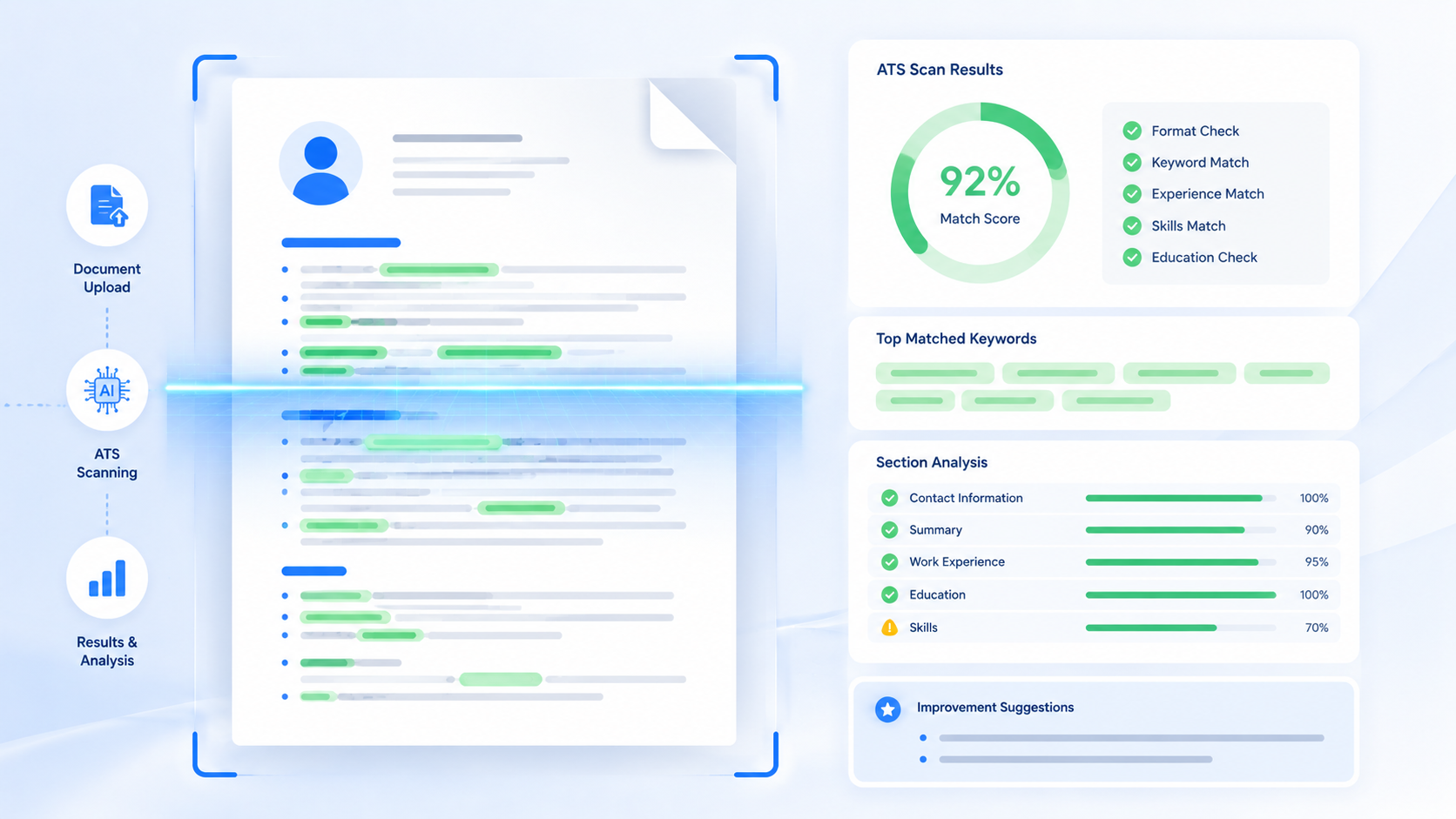
A beautiful resume can still fail if applicant tracking systems cannot read it correctly. Heavy design, text boxes, scanned PDFs, tables, icons, and unusual section labels can create parsing problems.
ATS-friendly formatting helps software extract your name, experience, skills, education, and dates. It also helps recruiters scan the resume quickly.
Formatting choices that can hurt
- Text placed inside images
- Important details in headers or footers only
- Complex two-column layouts
- Unusual section names like "My Journey" instead of "Work Experience"
- Charts used to show skill levels
- Scanned PDF files
Safer formatting choices
- Standard headings
- Simple bullet points
- Consistent dates
- Readable fonts
- Text-based PDF or DOCX when requested
AICV Create is designed to help job seekers create clean, ATS-friendly resumes without giving up a professional look.
Mistake 5: Missing Job Description Keywords
If your resume does not include the language of the job description, both software and recruiters may miss your fit. Keywords are not magic. They are simply the words employers use to describe what they need.
Keywords can include:
- Job titles
- Technical skills
- Software tools
- Certifications
- Industry terms
- Responsibilities
- Soft skills supported by examples
Example
If a job posting asks for "Excel, data analysis, dashboards, KPI reporting, and stakeholder communication," do not write only "worked with reports."
Better: Built Excel dashboards to track weekly KPI reporting and shared data analysis summaries with operations stakeholders.
Use keywords naturally. Do not paste a list of terms you cannot explain in an interview.
Mistake 6: A Vague Resume Summary
Your resume summary is valuable space. A vague summary wastes it.
A weak summary says you are motivated, passionate, detail-oriented, or hardworking without proof. A strong summary points directly to the role and gives evidence.
Weak summary
Motivated professional seeking a challenging role where I can grow and contribute to a great company.
Stronger summary
Entry-level marketing assistant with hands-on experience creating social media content, researching competitors, and building campaign reports in Google Sheets. Strong writing, organization, and Canva skills.
The stronger version tells the employer what kind of role you fit and what you can do.
Mistake 7: The Wrong Resume Length
A resume should be long enough to prove your fit and short enough to respect the reader's time.
For students, fresh graduates, and early-career job seekers, one page is usually best. For experienced professionals, two pages can be appropriate if the information is relevant. Three pages is rarely necessary outside academic CVs, federal resumes, or specialized technical portfolios.
Cut these first
- Old jobs unrelated to your target role
- Repeated bullets across multiple roles
- Generic skills that do not match the job
- High school details after college, unless highly relevant
- References available upon request
- Long paragraphs that could be bullets
Length is not the real issue. Relevance is. A one-page resume full of vague content is not better than a two-page resume full of strong, relevant evidence.
Mistake 8: Exaggerating or Lying
Stretching dates, inflating titles, inventing software skills, or claiming degrees you do not have can create serious problems. Employers may verify employment, education, certifications, and references. Even if a false claim gets you an interview, it can fall apart quickly when you are asked detailed questions.
CareerBuilder has reported that many HR managers have caught lies on resumes. The safer approach is to frame your real experience clearly.
Instead of exaggerating, translate honestly
Do not write: Managed company-wide operations.
If accurate, write: Coordinated weekly supply orders, updated shift checklists, and helped train three new team members on closing procedures.
The second version is honest and still valuable.
Mistake 9: Contact and Link Errors
This mistake sounds basic, but it happens. A wrong phone number, outdated email, broken portfolio link, or private LinkedIn page can cost you an interview before the employer ever speaks with you.
Check these details
- Your email address is professional.
- Your phone number is correct.
- Your voicemail is set up and appropriate.
- Your LinkedIn URL opens correctly.
- Your portfolio or GitHub links work.
- Your city and state match the roles you are targeting.
If you include links, test them from another device or browser. Do not assume they work because they work on your own computer.
Mistake 10: Ignoring the First Screen
Recruiters often make quick first-pass decisions. The top half of your resume needs to show your target role, strongest qualifications, and most relevant experience quickly.
If the top of your resume is crowded with a large name block, generic summary, unrelated objective, and too much white space, the reader may not reach your best evidence.
What should appear early
- Targeted summary
- Relevant skills
- Current or most relevant role
- Strongest achievement or project
- Important certification or degree, if required
Think of the first screen as your interview invitation pitch. It should make the reader want to keep going.
Final Resume Checklist Before You Apply
- Does the resume match the job description?
- Is your summary specific to the role?
- Do your bullets show results, tools, scope, or impact?
- Are the most relevant skills easy to find?
- Is the formatting ATS-friendly?
- Did you remove filler and outdated details?
- Are all dates, company names, and job titles accurate?
- Did you proofread carefully?
- Do your links work?
- Is the final file saved in the format the employer requested?
How AICV Create Helps You Avoid These Mistakes
AICV Create helps job seekers build cleaner, stronger resumes by organizing sections, improving bullet wording, checking ATS-friendly structure, and matching resume language to job descriptions. It is especially useful when you know your background is solid but your resume is not getting enough interviews.
You can start with your current resume or build a new one, then use AI-powered suggestions to make your summary, skills, and bullets more specific. The goal is not to make your resume sound fancy. The goal is to make your fit clear.
FAQ
What is the biggest resume mistake?
The biggest mistake is sending a generic resume that does not match the job. It makes your relevant skills harder to see and can weaken both ATS matching and recruiter review.
Can one typo cost me an interview?
Yes, especially for roles that require accuracy or communication. A typo does not always end your chances, but it can create doubt.
Is a two-page resume a mistake?
No, not always. One page is best for students and early-career candidates. Two pages can work for experienced professionals if every section is relevant.
Should I use the same resume for every job?
No. Tailor your summary, skills, and most relevant bullets for each job description while staying truthful.
What resume format causes ATS problems?
Text boxes, scanned images, complex tables, unusual headings, and heavy graphics can cause parsing problems. A clean text-based layout is safer.
How do I know if my resume is hurting my interviews?
If you meet the requirements but rarely get callbacks, review whether your resume is tailored, ATS-friendly, specific, error-free, and focused on results.
Conclusion
Most resume mistakes are not dramatic. They are small choices that make your qualifications harder to see: generic wording, weak bullets, missing keywords, confusing formatting, or errors that suggest you did not review the document carefully.
The fix is to make your resume specific, honest, readable, and relevant. Start with the job description. Show proof with clear bullets. Keep formatting simple. Proofread more than once. Then send a resume that makes the interview decision easier.
If you want help catching these issues before you apply, use AICV Create to build an ATS-friendly resume, improve weak bullet points, and export a polished PDF for your next application.