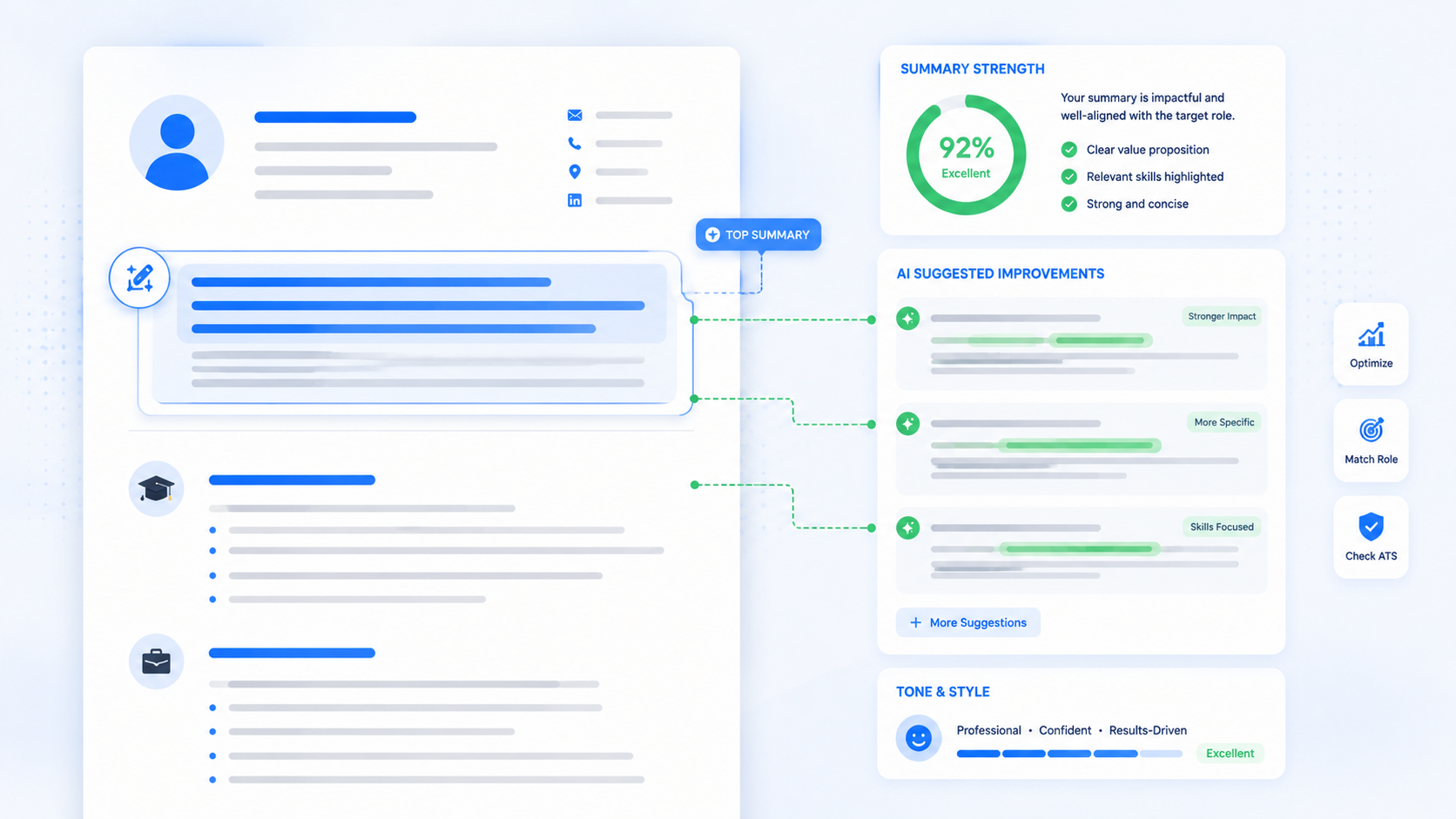
Recruiters spend just six seconds scanning your resume objective before deciding if you get an interview. If your application ends up in the trash, a weak introduction is likely the main reason why. Many job seekers use the wrong opening style, making them look unqualified or out of touch before a recruiter even reads their work history. Choosing the wrong format signals that you do not understand what modern employers want.
In this guide, you will learn how to choose between these two common formats based on your professional background. We will walk through the exact steps to build each style, review real-world samples, and look at the errors that trigger instant rejections. By the end of this article, you will know how to construct a header that grabs attention, passes automated scanners, and shows employers you are the right fit for the role.
TL;DR
- Use a resume objective if you are a student, recent graduate, or career changer.
- Use a resume summary if you have more than two years of relevant work experience.
- Avoid vague, self-centered statements and use clear numbers or metrics instead.
- Always customize your header keywords to match the specific job description.
Table of Contents
- The Difference Between an Objective and a Summary
- How to Write an Engaging Resume Introduction Step-by-Step
- Common Mistakes to Avoid in Your Resume Header
- Pro Tips for Writing an Outstanding Resume Opening
- Case Study: Rewriting a Resume Opening
- Build Your Resume Free with AICV Create
- Frequently Asked Questions
The Difference Between a Resume Objective and a Resume Summary
Think of your resume header like a movie trailer. A movie trailer does not show the entire film. Instead, it highlights the most exciting parts to convince you to buy a ticket. Your resume header needs to do the same thing for your career. If you choose the wrong format, the recruiter will close your application before they even look at your experience.
Hiring managers receive hundreds of applications for a single open position. They do not have time to read every word of your work history. Instead, they scan the top of the page to decide if you are worth their time. If your header is boring or confusing, they will move on. This is why choosing between an objective and a summary is a critical decision.
A resume objective is a short statement that focuses on your career goals and how you plan to help the employer.
A resume summary is a brief paragraph that highlights your past achievements, skills, and work history.
Here is a quick breakdown of what makes them different:
- Target Audience: Objectives are best for people with little experience, while summaries are for experienced workers.
- Main Focus: Objectives focus on future potential, while summaries focus on past track records.
- Core Message: Objectives explain why you want the job, while summaries show why you are qualified.
Many job seekers mistake a career objective for a generic sentence. They write things like "looking for a challenging role where I can grow." This tells the employer what you want from them, not what you can do for them. You can also read our full resume summary guide for more details.
How to Write an Engaging Resume Introduction Step-by-Step
Step 1: Assess your current career level
First, look at your professional background to decide which format fits your needs. If you are a college graduate, changing careers, or have less than two years of experience, you should write a resume objective. If you have several years of experience in the field, a resume summary is the better option. Choosing the wrong format can make you look underqualified, so this step is critical. For example, a senior manager using a simple objective will look like they lack achievements. If you have no work history, read our guide on writing a resume with no experience.
Beginners need to focus on their potential because they do not have a long work history. An objective lets you explain how your university projects or volunteer work prepare you for the job. On the other hand, senior professionals have a track record of success. A summary lets them highlight their biggest achievements right away, proving they can do the job from day one.
Step 2: Match your skills to the job description
Read the job advertisement and list the main skills the employer wants. You need to align your statement with the specific requirements of the role. Free tools like aicvcreate.com handle this automatically—you pick a template, fill in your details, and download an ATS-friendly resume that matches the job description. This ensures your resume matches what recruiters are looking for without manual guesswork.
To find these keywords, print out the job description and highlight the words that appear most often. Look for specific tools, software, or skills like project management or data analysis. Your opening statement should include at least two of these terms to catch the recruiter's eye and pass the automated filters.
Step 3: Draft your opening statement with metrics
Write your header statement using specific numbers and achievements. Even if you are writing an objective, you should include relevant numbers like your GPA, project budgets, or team sizes. Adding metrics shows that you focus on results, not just tasks. When you say you increased sales, it is a claim. When you say you increased sales by 15%, it is a fact. Even in an entry-level position, you can find metrics in your class projects, leadership roles in student clubs, or part-time customer service jobs. Here is a comparison of how to turn a weak draft into a strong statement:
| Before | After |
|---|---|
| Recent graduate looking for a marketing role where I can learn new skills. | Detail-oriented Marketing graduate with a 3.8 GPA and 6 months of social media internship experience. Seeking to increase online engagement for the brand by 15%. |
As you can see, the improved version focuses on what the candidate can do for the employer, rather than what they want from the company. Let's look at another example. If you want a job in sales, a weak draft might say "seeking a sales position where I can use my communication skills." A stronger version would say "Energetic Business graduate with one year of retail sales experience. Seeking to help your store exceed monthly sales targets by applying proven customer service skills." This change shifts the focus to the employer's goals.
Step 4: Keep your writing clear and concise
Limit your introductory statement to three or four sentences max. Recruiters review hundreds of profiles daily and will skip blocks of dense text. Focus only on the most important points that show you are ready for the role. Keep it tight, punchy, and easy to read. Avoid long words or sentences that make the reader work hard to understand your message. To keep it short, remove fluff words like "successful" or "results-oriented." Let your experience and numbers prove you are successful instead of just saying it. If a sentence does not add value, delete it from your draft.
Step 5: Review resume objective examples to check your tone
Compare your finished text with successful templates from your industry. Reading other samples helps you see if your tone is professional, confident, and direct. Make sure your final draft sounds natural and does not use cliches. Look at how successful candidates highlight their credentials and copy their structure to make your own writing stronger. Ask a friend or mentor to read your draft. If they cannot understand what job you are applying for within five seconds, your opening is too vague. You should continue to refine it until the message is crystal clear.
Common Mistakes to Avoid in Your Resume Header
Many job seekers write their resume intro in a hurry. However, making a single mistake in this section can cause recruiters to discard your application immediately. Avoid these four common errors when writing your introduction:
- Focusing only on what you want. Many candidates write about their personal career aspirations. They say they want a company that will help them learn and grow their skills. While this is a great goal for your career, employers want to know what you can do for them first. Your header must show how your skills will solve their business problems from the first day you join.
- Using cliches and empty buzzwords. Words like "self-motivated" or "hard worker" are used by almost every applicant. Because they are so common, they lose their meaning and look like filler text. Replace these generic words with concrete skills, technical training, and achievements that prove your value. For example, instead of writing "hard worker," mention a school project where you managed a team under a tight deadline.
- Writing a giant block of text. If your introduction looks like a wall of text, the recruiter's eyes will skip over it. Use simple formatting and short sentences. Keeping your intro under four lines ensures that the recruiter reads every word without getting bored.
- Forgetting to tailor the statement. Using a single generic resume for every application is a major reason why job seekers get rejected. Recruiters can tell immediately if you copied and pasted your intro. Customize the keywords and job titles for every role you apply to.
Pro Tips for Writing an Outstanding Resume Opening
If you want to beat the competition, you need to go beyond the basics. A great introduction does more than just state your job title; it tells a story about your professional value. Use these advanced strategies to stand out from the crowd:
- Start with a strong professional trait. Instead of starting with "I am," begin with a powerful adjective like "Detail-oriented," "Analytically-minded," or "Resourceful." This shows you are professional and ready to work. If you look at successful resume objective examples, you will notice they always start with a strong trait. Choose an adjective that directly matches the tone of the job description.
- Match the company culture. Research the company to see if they prefer a formal or casual tone. Align your writing style with their website to show you are a good cultural fit. If they are a traditional financial firm, keep your writing formal and direct. Matching their style shows you understand their brand.
- Use active verbs. Avoid passive phrases. For example, instead of saying "responsible for social media accounts," write "managed social media accounts." Make sure your resume summary uses active verbs instead of passive phrases to keep the reader engaged. This simple change makes you sound like a leader who takes action.
★ PRO TIP: Use a tool like aicvcreate.com to test different versions of your header. The platform offers instant AI writing suggestions that help you find the best keywords for your target industry, making it easy to create an ATS-friendly resume. The AI tool helps you find the perfect balance between active verbs and industry-specific keywords, ensuring you stand out to both computers and humans.
Case Study: Rewriting a Resume Opening for a Career Changer
Let's look at a real-world example to see how this works. We helped a college senior rewrite their resume objective to target junior developer roles. The candidate had a degree in biology but wanted to switch to software engineering.
Here is what they had originally:
"Biology graduate looking to transition into software engineering. I want to work for a company where I can learn programming languages and build software."
This draft has several problems. It focuses on what the candidate wants to learn, not what they can do. It also does not highlight any of their programming skills.
We helped them rewrite it to focus on their projects and technical skills:
"Self-taught programmer and Biology graduate with 1+ years of experience building Python applications. Seeking to apply backend development skills to help target company build reliable database solutions."
Why did this change work? First, it immediately states their technical skills (Python) and how long they have been coding. Second, it focuses on helping the target company build solutions rather than asking the company to teach them. As a result, the candidate received three interview calls within two weeks of updating their application.
We also worked with a graphic designer who had three years of freelance experience but wanted a full-time corporate role. Their original summary was:
"Freelance graphic designer with experience in branding. Seeking a full-time role at a design agency."
We helped them rewrite it to emphasize their client work and results:
"Creative Graphic Designer with 3+ years of freelance experience delivering brand identity packages. Seeking to join a design agency to lead visual strategy and improve client retention by 20%."
This new version worked because it showed their industry experience and set a clear goal. The candidate was able to secure multiple interviews because they proved their value immediately.
Build Your Resume Free with AICV Create
Writing a resume does not have to be difficult. Our builder helps you choose the right format and customize it for your dream job. You can create a professional document that stands out to recruiters in just a few minutes.
- ATS-friendly templates that pass automated scanners
- AI writing suggestions to improve your wording
- Instant PDF download with no hidden fees
→ Create your free resume at aicvcreate.com — no account needed to get started.
Frequently Asked Questions
Should I use a resume objective or a summary?
Use a resume objective if you are a student, recent graduate, or career changer with little experience. If you have more than two years of work experience in your field, use a summary to highlight your professional achievements.
How long should a resume summary be?
A resume summary should be between three and four sentences long, or about 50 words. Keep it short and punchy so that busy recruiters can scan it in under five seconds and quickly understand your value.
Where can I find resume objective examples for freshers?
You can find resume objective examples for freshers on major job search blogs and resume writing sites. Look for templates that match your specific industry and show how to highlight academic projects and internships.
Is a career objective the same as a resume objective?
Yes, they are the same. Both terms refer to the short introduction at the top of your resume that explains your career goals and how you plan to add value to the hiring company.
How do I make an ATS-friendly resume?
To build an ATS-friendly resume, use simple formatting, clear headings, and keywords from the job description. You can use aicvcreate.com to build your resume free. It offers templates and automated suggestions to ensure your file passes scanning systems.