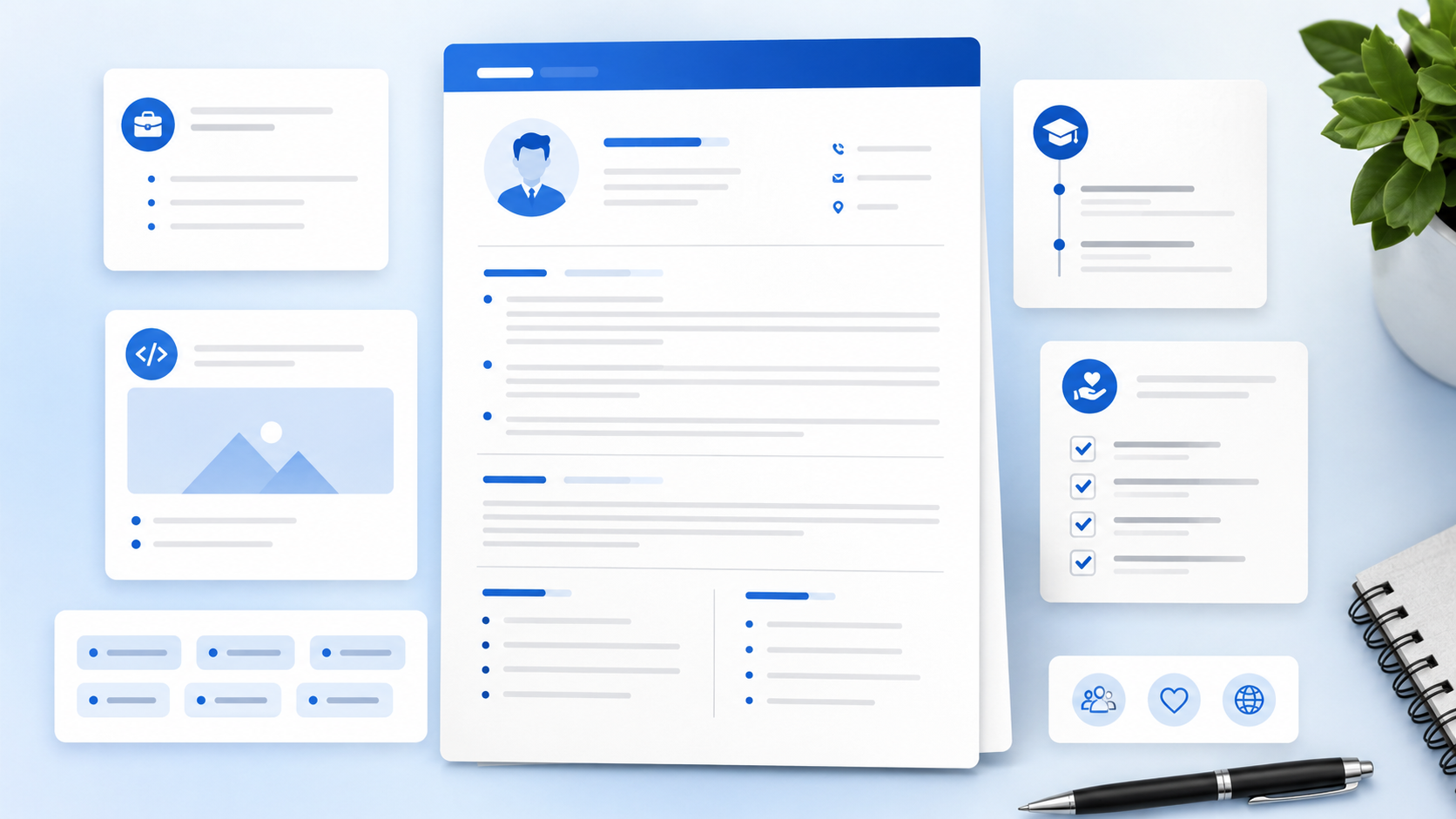
Most resume examples look helpful until you try to write your own and realize the sample does not match your background. A good example should do more than show a polished page. It should teach you how to choose the right details for a real job.
This guide shows you how to use resume samples without copying them, what different job seekers should include, and how to turn a basic example into a stronger, ATS-friendly resume. You will see practical sample wording for students, freshers, career changers, and working professionals.
TL;DR
- Use resume examples as structure guides, not copy-and-paste text.
- Pick a sample that matches your career level and target job.
- Strong examples show proof, tools, context, and results.
- CV examples may be longer for academic or international use.
- Tailor each resume sample before you send an application.
Table of Contents
Why Resume Examples Can Help or Hurt
Resume examples help when they show the shape of a strong application. They hurt when you copy phrases that do not fit your real experience. Recruiters can spot generic wording quickly, especially when the same phrases appear across many applications.
Think of a resume sample like a floor plan. It can show where the rooms go, but it cannot furnish the house for you. Your skills, projects, work history, and results still need to be real.
- Good examples show clear sections, relevant skills, and proof-based bullets.
- Weak examples use vague claims such as "hard worker" without evidence.
- Useful CV examples match the country, field, and experience level you need.
- Strong samples make the target job obvious from the top half of the page.
How to Use Resume Examples the Right Way
Step 1: Choose an example for your career stage
Pick a resume sample that matches where you are now.
A college student should not follow a senior manager resume. A career changer should not use a sample that depends on 10 years of direct industry experience. The closer the example is to your situation, the easier it is to adapt.
Step 2: Study the structure before the words
Look at the order of sections, spacing, headings, and bullet length first.
Most job seekers rush to copy sentences. Instead, ask why the sample works. Does it put projects above work history? Does it lead with technical skills? Does it keep the summary short?
If you're a student picking a structure to follow, see the best resume format for college students.
Step 3: Rewrite the sample with your proof
Replace every generic line with a real task, tool, result, or project.
If a sample says "improved team productivity," ask what you actually improved. Maybe you organized shared files, answered customer questions faster, created a spreadsheet tracker, or helped a student group plan events.
Free tools like AICV Create help with this step because you can enter your real details, get cleaner wording suggestions, and keep the final resume formatted for ATS systems.
Step 4: Compare weak and strong sample wording
Use examples to learn how strong bullets are built.
| Weak sample wording | Stronger resume example |
|---|---|
| Helped customers and worked on the register. | Assisted 40+ customers per shift, processed purchases, handled returns, and answered product questions during busy store hours. |
| Made social media posts for a club. | Created weekly Instagram posts for a campus club, tracked engagement, and helped increase event sign-ups through clearer captions. |
| Worked on a software project. | Built a React task tracker with form validation, reusable components, and local storage for a class project. |
The stronger examples name what happened. They show action, context, and proof. That is what you want your own resume to do.
Step 5: Tailor the example to the job description
Change the summary, skills, and top bullets for each job.
If the employer asks for Excel, scheduling, and customer service, your resume should show honest proof of those areas near the top. A beautiful resume that does not match the job will still feel off.
For the full process, see how to match your resume to a job description.
Resume Sample Mistakes to Avoid
- Copying the exact text: Copied wording can sound fake and may not match your real background. Use the structure, then write your own proof.
- Choosing a sample above your level: A senior-level example can make a fresher resume look padded. Pick a sample close to your experience.
- Ignoring ATS readability: Some CV examples use graphics, icons, and complex columns that look nice but may parse poorly. Keep the layout clean.
- Using the same version everywhere: One general resume rarely fits every role. Tailor the top third for each application.
- Adding skills you cannot explain: A sample may list tools you do not know. Do not add them unless you can discuss them in an interview.
Pro Tips for Better CV Examples
- Build a master resume first. Keep all jobs, projects, tools, coursework, and wins in one document, then pull the best parts for each application.
- Match the sample to the job family. Admin, tech, healthcare, sales, and student resumes should not all look the same.
- Use section order as a strategy. Put education higher if you are a student. Put experience higher if your work history is stronger.
- Look for verbs with proof. Good examples use words like built, handled, trained, tracked, resolved, supported, organized, and improved.
★ PRO TIP: If a resume example has a sentence you want to copy, pause and ask, "What is my real version of this?" The answer becomes stronger and more honest than the sample.
AICV Create can help you test different resume templates, improve bullet wording, and download a clean PDF after your content is ready.
Resume Examples by Job Seeker Type
Student resume example
Summary: Business student with coursework in communication, Excel, and project coordination, seeking an entry-level administrative role. Experienced in campus event planning, meeting notes, and student group scheduling.
Bullet: Coordinated room bookings, volunteer schedules, and reminder messages for three campus club events with 40+ attendees each.
Fresher resume example
Summary: Entry-level customer support candidate with retail experience, strong written communication, and hands-on practice using spreadsheets to track orders and follow-ups.
Bullet: Answered customer questions, documented common issues, and helped resolve return requests during high-volume weekend shifts.
Career changer resume example
Summary: Former teacher moving into training coordination, bringing lesson planning, presentation, documentation, and learner support experience.
Bullet: Created weekly learning plans, tracked student progress, and adjusted materials for different skill levels across multiple classes.
Professional resume example
Summary: Operations coordinator with 5 years of experience supporting scheduling, vendor communication, inventory records, and reporting for busy service teams.
Bullet: Maintained weekly supply reports, flagged low-stock items, and coordinated vendor follow-ups to reduce last-minute shortages.
Software engineer resume example
Summary: Junior software engineer with React, Node.js, API, and Git project experience, focused on building clean interfaces and reliable backend features.
Bullet: Built a task management app with React components, Express routes, form validation, and basic user authentication for a portfolio project.
For more, see these software engineer resume examples.
Before and After Resume Example
Before: "Responsible for helping customers, keeping the store clean, and doing other tasks as needed."
After: "Supported customers during busy shifts, processed purchases and returns, restocked high-demand items, and kept checkout areas organized for faster service."
The after version works because it removes vague language. It shows action and setting. It also gives the recruiter a clearer picture of how the applicant worked.
You can do the same with any resume sample. Start with a plain duty, then add the action, tool, customer, project, or result. Keep it honest and specific.
Simple Resume Template You Can Adapt
Use this order for most U.S. job applications:
- Name and contact details: email, phone, city/state, LinkedIn or portfolio if useful.
- Professional summary: two to four lines focused on the target job.
- Skills: 8 to 15 relevant tools, technical skills, or workplace strengths.
- Experience or projects: proof-based bullets with action and context.
- Education: degree, school, graduation date, coursework, honors, or certifications when relevant.
For students and freshers, projects can come before work history. For experienced professionals, work history should usually come first. The best template is the one that puts your strongest proof where a recruiter will see it quickly.
How to Choose the Best Resume Example
The best resume example is not always the prettiest one. It is the one that makes your next job feel easy to understand. Before you follow any sample, compare it with the job posting and your strongest proof.
- Choose a sample with the same career level.
- Choose a layout that keeps text easy to scan.
- Choose examples with bullets you can rewrite honestly.
- Choose a template that still works when saved as a PDF.
If two examples both look good, pick the simpler one. Clear resumes usually beat busy resumes because recruiters and ATS software can read them faster.
Build Your Resume Free with AICV Create
Resume examples are useful, but your final resume needs your own details. AICV Create helps you turn those details into a clear, job-ready resume without fighting the layout.
- ATS-friendly templates for clean formatting
- AI writing suggestions for summaries and bullet points
- Instant PDF download, free to start
→ Create your free resume at aicvcreate.com — no account needed to get started.
FAQ
What are resume examples?
Resume examples are sample resumes that show how to organize your summary, skills, work history, education, and projects for a specific role. They help you see strong wording and layout before writing your own version.
How should I use a resume sample?
Use a resume sample as a structure guide, not text to copy. Match the section order and bullet style, then rewrite each part with your own honest skills, projects, results, and job details.
Is a CV example the same as a resume example?
In the United States, a resume is usually short and job-focused. A CV can be longer for academic or research roles. In some countries, CV examples and resume examples mean nearly the same thing.
Can I use the same resume example for every job?
No. Start with one strong example, then tailor your summary, skills, and bullets for each job description. Employers want to see proof that matches their role, not a general resume sent everywhere.
Does AICV Create include resume examples?
AICV Create helps you build from guided sections, templates, and writing suggestions. You can use examples from this guide, enter your real details at aicvcreate.com, and download an ATS-friendly resume.