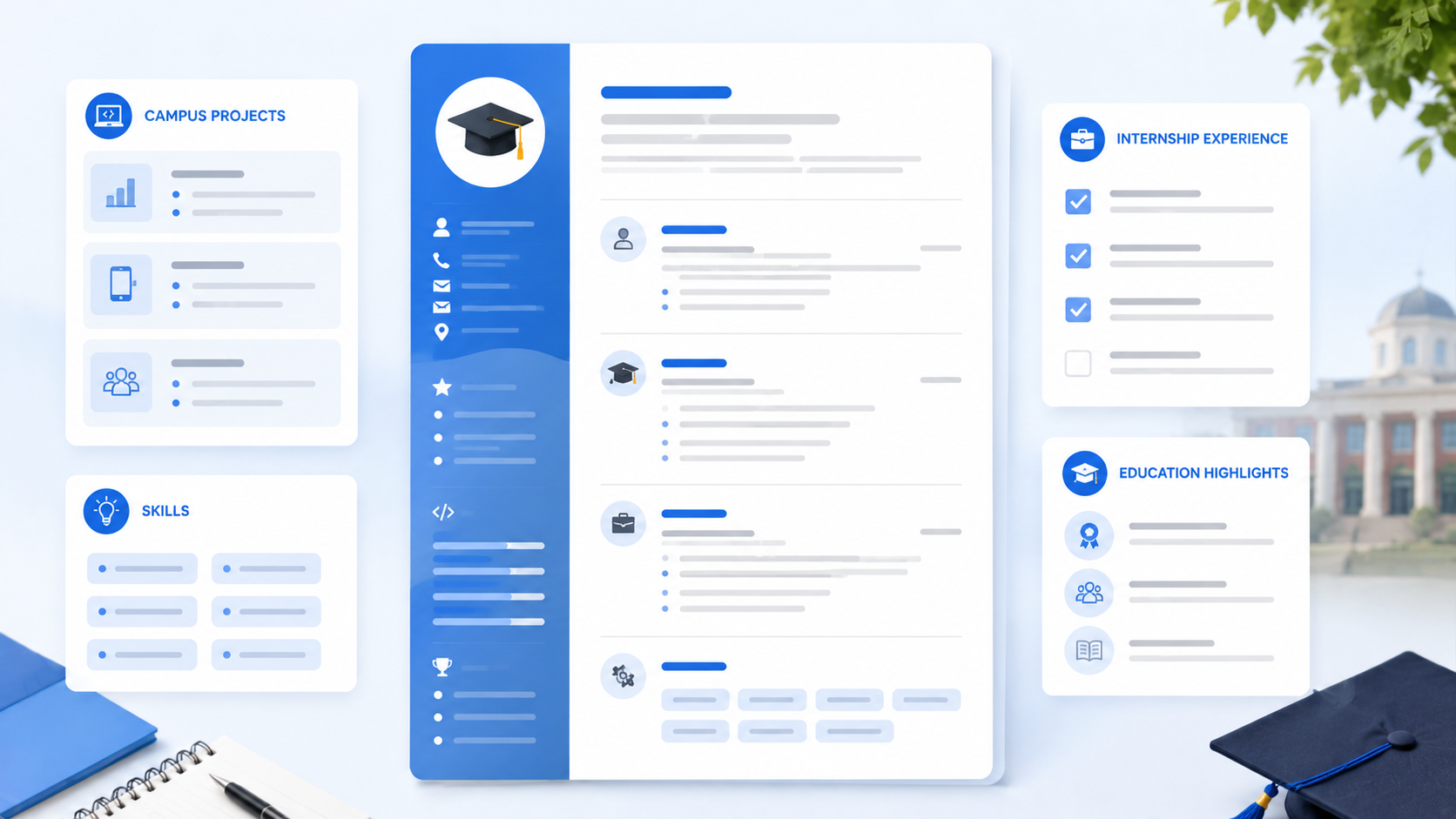
Most freshers lose interviews before anyone reads a single line of their experience — because they don't have any yet, and they don't know what to put in its place. A strong resume for freshers isn't about faking a work history. It's about proving you're ready without one.
This guide walks you through exactly what to include in your first CV, step by step, plus the mistakes that quietly cost freshers interviews and pro tips that make a thin resume look genuinely strong. You'll also see a real before-and-after example.
TL;DR
- Lean on education, projects, and coursework instead of work history.
- Write a summary with a target role, skills, and one proof point — never a generic line.
- Use action, task, tool, result for every project or internship bullet.
- Keep the format simple, single-column, and to one page.
- Never send the same resume to every job without small tailoring.
Table of Contents
Why a Fresher Resume Is Judged Differently
Recruiters don't expect a first resume to look like a ten-year professional's. They're checking for something else entirely: can you learn fast, communicate clearly, and handle real responsibility.
Think of it like a job interview for an apprentice, not a master craftsman. Nobody expects finished expertise. They're looking for signs of the raw material.
Recruiters reviewing entry-level applications know they're not comparing years of history. They're comparing potential, and potential shows up in specific, describable habits rather than job titles.
A resume for freshers usually gets judged on:
- Academic performance and relevant coursework
- Internships, part-time work, or volunteer roles
- Class projects, competitions, or personal projects
- Communication skills shown through writing and structure
- Basic professionalism — no typos, no gimmicks
None of these require years on the job. They just require you to present what you already have with more intention.
A no experience resume doesn't need to hide the fact that you're just starting out. Trying to disguise it usually backfires, since recruiters can tell right away when a summary is stretching the truth.
Instead, the goal is to reframe what "experience" means. Group projects, part-time jobs, and volunteer work are all real evidence of how you work — they just need to be described the right way.
For a deeper dive into this angle, see how to write a resume with no experience.
How to Write Your First CV, Step by Step
Follow these steps in order to build a fresher resume that actually holds up under review.
Step 1: Pick a Simple, Reverse-Chronological Format
Use a single-column, one-page layout with clear section headings. Avoid creative templates with sidebars, icons, or graphics — they can confuse applicant tracking systems before a person even opens your file.
This step matters even more for a first resume, since you have fewer sections to work with. A clean, readable layout makes the little experience you do have easier to notice.
Step 2: Write a Summary That Replaces Experience With Direction
Open with two to three lines naming your target role, your strongest skills, and one proof point. Skip generic lines like "hard-working fresher looking for an opportunity" — they say nothing about you specifically.
A good summary works like a trailer for the rest of the resume. It should make a recruiter want to keep reading, not just fill space at the top of the page.
| Before (Generic) | After (Specific) |
|---|---|
| "Motivated fresher looking for a chance to prove myself" | "Computer science graduate with two Python projects and a completed data analytics internship" |
| "Hard worker with good communication skills" | "Organized 3 campus events for a 200-member student club, coordinating vendors and schedules" |
Free tools like AICV Create handle this automatically — you pick a template, fill in your details, and its AI suggestions help turn a thin work history into a clear, specific summary.
Step 3: Let Your Education Section Do More Work
List your degree, expected graduation date, relevant coursework, and any strong academic results. For a first resume, this section often carries as much weight as work experience would later.
Pick coursework selectively. Three or four classes that connect directly to the job matter more than a long list of every subject you've studied.
Step 4: Turn Projects and Internships Into Real Bullet Points
Use the same formula recruiters expect from experienced candidates: action, task, tool, result. A class project described with real specifics reads stronger than a vague internship description.
Even a small project counts if you describe it with enough detail. "Built a budget spreadsheet for a student event with 150 attendees" says far more than "helped organize an event."
Step 5: Add a Skills Section That Matches the Job Posting
List 8 to 12 relevant skills, mixing technical tools with communication and teamwork skills. Only include skills you can actually explain if asked about them in an interview.
Step 6: Proofread Before You Send It Anywhere
Read your resume out loud and check every date, spelling, and contact detail. A single typo can undercut an otherwise strong first resume, since it's often the only sample of your work a recruiter has seen.
Common Mistakes Freshers Make on Their First Resume
- Padding the resume with irrelevant details. Listing every school activity since childhood dilutes the details that actually matter for the job you want.
- Writing duties instead of proof. "Worked on a group project" tells a recruiter nothing. "Built a budget tracker in Excel for a five-person class project" tells them everything.
- Using an overly designed template. Icons, columns, and colored sidebars can look impressive but often break formatting when scanned by hiring software.
- Leaving out a skills section entirely. Many freshers assume their education says enough, but a clear skills list gives recruiters and applicant tracking systems an easy match.
- Sending the exact same resume to every job. Even with limited experience, small adjustments to match each job description meaningfully improve your response rate.
- Adding a photo, age, or personal details out of habit. Most modern resumes, especially for entry-level roles, don't need these details and they can take up space better used for proof of skill.
Most of these mistakes are easy to fix once you know to look for them. A quick pass through this list before you apply can make a thin resume feel a lot more solid.
Pro Tips for a Fresher Resume That Stands Out
- Lead with your strongest section, not the traditional order. If your projects are more impressive than your coursework, put them higher on the page.
- Quantify class projects like real work. A group size, a budget, a percentage improvement — any number adds weight to an otherwise vague line.
- Add a link to real proof. A GitHub profile, portfolio, or writing sample can matter more than another bullet point of text.
- Keep it to one page. A short, focused resume reads as more confident than a stretched two-page version padded with filler.
- Mention any freelance or informal work, even unpaid. Helping a family business with its social media or building a website for a local club still counts as real, describable experience.
None of these tips require inventing experience you don't have. They just help you present the real experience you do have more clearly.
★ PRO TIP: Build a "master resume" with every project, award, and skill you can think of, even ones you won't use for every job. Then trim a focused, one-page version from that master list for each specific application.
This habit saves time on every future application, since you'll be trimming and rearranging instead of starting from a blank page each time you apply somewhere new.
Before you send anything out, run through the full ATS resume format checklist to catch formatting issues.
AICV Create's AI writing suggestions can flag vague lines and suggest stronger phrasing as you build, which helps a lot when you're not sure how to describe your first real project.
Real Example: A Fresher Resume Before and After
Aditi, a recent business graduate, had been applying for entry-level marketing roles for two months without a single response. Her resume listed her degree and a line that read: "Completed coursework in marketing and worked on group projects."
She rewrote it using specifics from her actual coursework: "Built a social media campaign proposal for a local bakery using audience research and competitor analysis, presented to a class of 40 peers."
For background on why format matters this much, see what an ATS resume actually is.
Within two weeks of sending her updated resume for freshers, she had three interview invitations. Her experience hadn't changed — she'd just finally described it clearly enough for someone to see the fit.
She made the same kind of edit to her other two bullet points, adding numbers and specific tools wherever she could. The whole rewrite took about an hour, spread across one evening.
Her final resume still fit on one page, and she didn't add a single new experience to her history. She just made sure every line answered the question a recruiter was actually asking.
Aditi's case is a good reminder that a no experience resume doesn't need more content to work better. It usually just needs the content it already has described with more precision.
Build Your Resume Free with AICV Create
Your first CV doesn't need years of experience to look strong — it needs the right structure and clear proof. AICV Create gives freshers a ready-made, ATS-tested layout so you can focus on describing what you've actually done.
- ATS-friendly templates built for first-time job seekers
- AI writing suggestions that turn thin experience into clear bullet points
- Instant PDF download, free to start, no design skills needed
→ Create your free resume at aicvcreate.com — no account needed to get started.
FAQ
What should a resume for freshers include?
Include contact details, a short summary, education, relevant coursework, projects or internships, and a skills section. Since work history is limited, education and projects usually carry more weight than they would for experienced candidates.
How do I write a first resume with no work experience?
Use school projects, internships, volunteer work, and coursework as proof of your skills. Focus on specific actions and results instead of vague descriptions, and keep the whole resume to one page.
Is a resume for freshers different from a regular resume?
Yes, mainly in emphasis. A fresher resume leans more heavily on education, projects, and skills, while an experienced resume leans on work history and measurable results from past jobs.
How long should it take to write a first CV?
Most freshers can finish a solid first draft in about an hour once they've gathered their coursework, projects, and skills. Using a free tool like AICV Create can cut that down to 20-30 minutes.
Is aicvcreate.com really free?
Yes. AICV Create is free to use with core features including resume editing, ATS-friendly templates, and PDF export. Pro plans unlock unlimited resumes, AI writing, and advanced tools — but you can build and download a complete resume without paying anything.