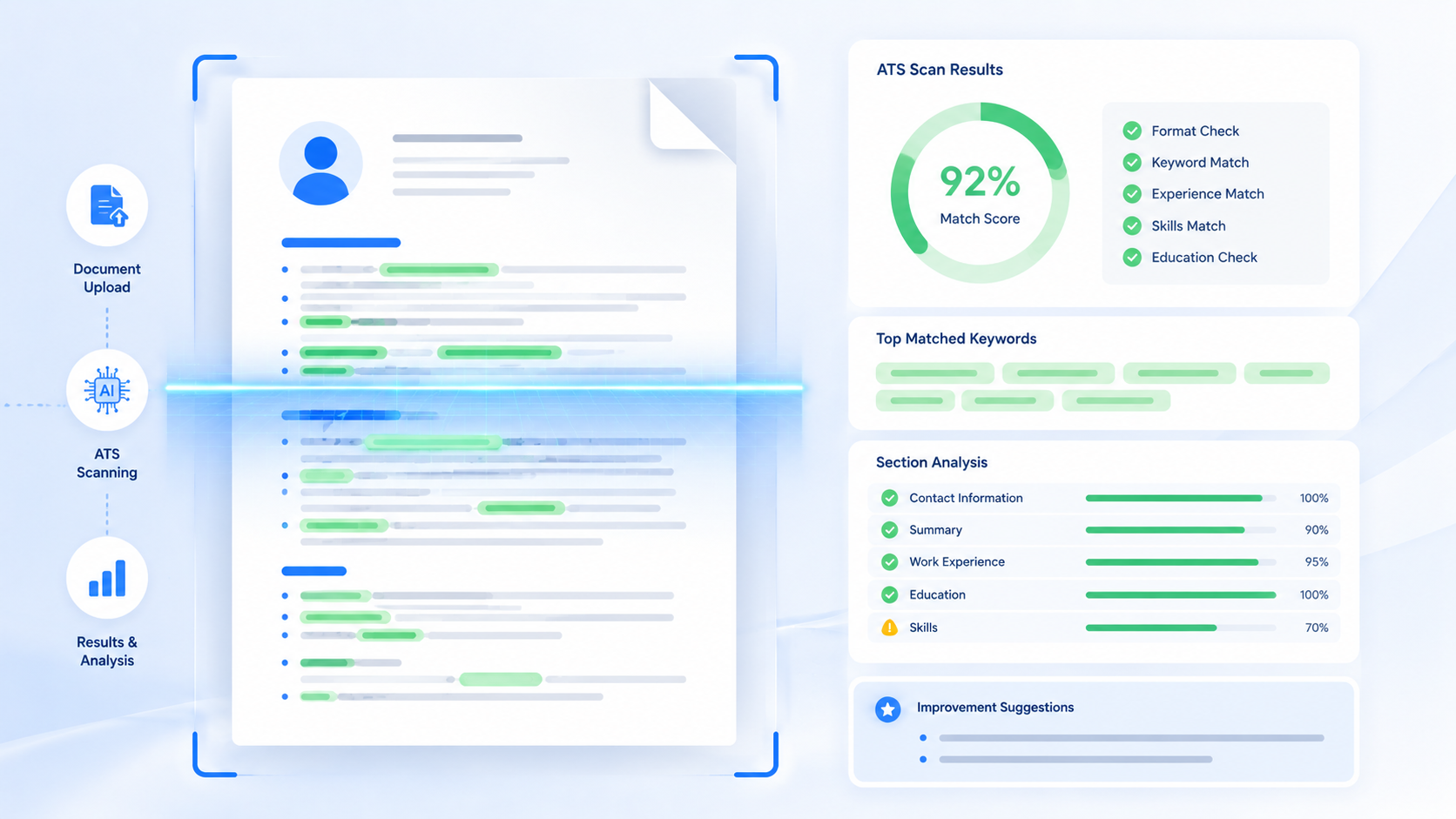
Most resumes do not need more decoration. They need sharper proof. These resume tips 2026 will help you show the right details faster, pass basic ATS checks, and make the recruiter want to keep reading.
You will learn 15 practical resume tips, the mistakes that quietly hurt interviews, and a simple before-and-after example. The advice is built for students, freshers, career changers, and professionals who want clearer applications without sounding fake.
TL;DR
- Tailor the top third of your resume for each job.
- Use bullet points that show action, tools, and results.
- Keep the design clean and ATS-friendly.
- Put your strongest proof before weaker details.
- Use AI help carefully, then review every line yourself.
Table of Contents
Why Resume Tips 2026 Focus on Proof
Recruiters do not have time to decode vague resumes. Online systems scan for structure and keywords, while people scan for proof. That is why good resume advice in 2026 is less about fancy templates and more about clear evidence.
Think of your resume like a movie trailer. It does not show every scene. It shows the right moments so someone wants the full story.
- Keywords help systems read your fit.
- Results help recruiters trust your value.
- Clean layout helps both humans and software.
- Specific examples beat generic claims.
15 Resume Tips That Actually Get Interviews
1. Match the resume to one job
Do not send the same resume everywhere. Change your summary, skills, and top bullets so they match the role.
If the job asks for scheduling and Excel, those words should appear naturally where your experience supports them.
2. Put your strongest proof first
The top third of your resume matters most. Use it for your best title, summary, skills, recent work, project, or education.
For freshers, that may mean projects and coursework. For experienced applicants, it usually means recent work wins.
3. Use a clean resume format
Simple formatting wins. Use clear headings, normal margins, readable font size, and enough white space.
For more layout help, see our resume format guide for 2026.
4. Write bullets with action and proof
Start each bullet with an action. Then explain what you did, what tool you used, or what changed.
Weak: “Responsible for reports.†Better: “Prepared weekly Excel reports for inventory updates and manager review.â€
5. Use numbers when they are real
Numbers help recruiters understand scope. Use real numbers for customers, projects, reports, sales, time, team size, or output.
No number is better than a fake number. If you do not know the metric, use specific nouns instead.
6. Add keywords without stuffing
Use keywords from the job description when they truly match your background. Put them in your summary, skills, and bullets.
Do not paste a hidden keyword list. It looks dishonest and can backfire.
7. Make your summary useful
Your summary should tell the recruiter who you are, what you can do, and why you fit the role.
Keep it short. Two to three lines are enough for most applicants.
8. Keep the skills section focused
List 8 to 15 skills that matter for the job. Mix tools, technical skills, and workplace strengths.
For a deeper list, read best skills to put on a resume in 2026.
9. Show projects if experience is thin
Projects can prove ability when you have limited work history. Include class projects, portfolio work, volunteer work, or personal builds.
Explain the goal, tools, and result. Do not just list the project name.
10. Remove weak filler
Words like hard-working and passionate are weak without proof. Replace them with facts.
Show the behavior through examples: trained staff, handled customers, built reports, wrote documentation, or led a team task.
11. Save as PDF unless told otherwise
PDF keeps your layout stable. Use Word only when the employer asks for it.
Name the file clearly, such as Maria-Gomez-Resume.pdf.
12. Keep one master resume
Your master resume can include everything. Your application resume should include only the most relevant details.
This makes tailoring easier because you are choosing from a strong source instead of starting from scratch.
13. Use AI for drafts, not lies
AI can help with wording, but it cannot invent your experience. Review every line.
Free tools like AICV Create help turn your real details into cleaner summaries and bullets without forcing you to fight formatting.
14. Test the resume like a recruiter
Scan your resume for 10 seconds. Can you see the job fit quickly?
If not, move the strongest details higher and cut weaker content.
15. Proofread the boring details
Check dates, spelling, links, phone number, email, spacing, and file name.
Small errors can make the whole resume feel careless.
16. Make every section earn its space
If a section does not help the employer choose you, cut it or shorten it. Space is limited, especially on a one-page resume.
For example, a hobbies section may help for a coaching role, but it probably does not help much for a data entry role. Use that space for skills, tools, or proof instead.
17. Keep tense consistent
Use present tense for your current role and past tense for older roles. This small detail makes your resume easier to read.
Write “manage weekly reports” for work you still do. Write “managed weekly reports” for work from a past job.
Resume Mistakes to Avoid
- Writing a long objective: Employers care less about what you want and more about what you can do.
- Listing every job task: A resume should highlight relevant proof, not repeat your full job description.
- Using too many design elements: Graphics and complex columns can hurt readability and ATS parsing.
- Ignoring the job description: If your resume does not match the role, it feels random.
- Sending without proofreading: A broken link or wrong phone number can cost you the interview.
Advanced Resume Advice Most People Skip
- Use a proof stack. Pair every important skill with one bullet that proves it.
- Cut old details first. If space is tight, remove older or unrelated content before cutting relevant recent proof.
- Make the first bullet strongest. Recruiters often read the first bullet under each role before deciding whether to continue.
- Use role language carefully. Mirror the job title when your experience supports it.
★ PRO TIP: After you tailor your resume, compare the first half page to the job posting. If the match is not clear there, it is probably not clear enough.
AICV Create can help you revise faster because you can edit sections, get AI writing suggestions, and export a clean PDF when the content is ready.
Before and After Resume Tip Example
Before: “Worked in customer service. Helped customers and answered questions.â€
After: “Answered customer questions by phone and email, documented issues in the CRM, and helped resolve order problems during high-volume shifts.â€
The after version works because it shows channel, tool, task, and context. It gives the recruiter something real to judge.
If your resume gets no replies, compare it with resume mistakes that cost interviews.
A 10-Minute Resume Review Plan
You do not need a full rewrite every time. Before sending an application, use this quick review plan.
- Minute 1: Check the job title and make sure your summary points toward that role.
- Minutes 2-3: Compare the required skills with your skills section and remove anything unrelated.
- Minutes 4-6: Improve the first two bullets under your most relevant job or project.
- Minutes 7-8: Check formatting, spacing, dates, and file name.
- Minutes 9-10: Open every link and save the final PDF.
This quick pass works because most resume problems are near the top of the page. If the first screen is clear, the rest of the resume has a better chance.
What to Cut From Your Resume
One of the most useful resume tips is knowing what to remove. A stronger resume is not always longer. It is more focused.
- Remove old school details once college or work experience is stronger.
- Remove hobbies unless they connect to the role.
- Remove repeated bullets that say the same thing in different words.
- Remove software you cannot use confidently in an interview.
- Remove references and the phrase references available upon request.
Cutting weak details gives your strong details more room to breathe. That makes the resume easier to read and easier to trust.
Build Your Resume Free with AICV Create
You can apply these resume tips faster with a tool built for job seekers. AICV Create helps you organize your content, improve wording, and download a polished resume.
- ATS-friendly templates
- AI writing suggestions for summaries and bullets
- Instant PDF download, free to start
→ Create your free resume at aicvcreate.com — no account needed to get started.
If you only have time for one improvement, rewrite the first bullet under your most relevant experience. That bullet often sets the tone for the rest of the resume. Make it specific, useful, and connected to the job.
Then read the top half of the page once more. If it sounds like it belongs to the job you want, you are much closer. If it sounds generic, tailor the summary and first few bullets again before you upload the file. A few careful edits can change how the whole application feels.
FAQ
What are the best resume tips for 2026?
The best resume tips are to tailor your resume, use a clean format, write proof-based bullets, include relevant keywords, and keep your strongest details near the top. Clear proof matters more than design tricks.
How can I make my resume get more interviews?
Match your resume to the job description, show results instead of duties, keep formatting simple, and remove details that do not support the role. A focused resume is easier for recruiters to shortlist.
Is one resume enough for every job?
No. Keep a master resume with all your details, then create a tailored version for each job. Update your summary, skills, and top bullets so the match is clear.
Can a resume builder improve my resume?
Yes. A builder like aicvcreate.com can help you structure sections, improve bullet wording, use ATS-friendly templates, and download a clean PDF faster than editing from scratch.
Should I use AI to write my resume?
AI can help improve wording, but you should review every line. Keep details honest, specific, and based on your real work, projects, education, or skills. Never add experience you cannot explain.