TL;DR
- Use the job description as your first source for resume skills.
- List 8 to 15 relevant skills, not every tool or trait you have ever used.
- In 2026, employers care about both technical ability and human skills: AI literacy, data analysis, communication, teamwork, problem-solving, adaptability, and leadership.
- Do not only list skills. Prove your strongest skills in bullets, projects, internships, coursework, or certifications.
- For ATS-friendly resumes, use clear skill names such as Excel, SQL, customer service, project coordination, Python, Salesforce, or data visualization.
Table of Contents
The Best Skills for Resumes in 2026
A strong resume skills section should help both applicant tracking systems and recruiters understand your fit. That means the best skills are not random popular words. They are the skills the employer asked for, written in language the employer recognizes, and supported by evidence elsewhere on the resume.
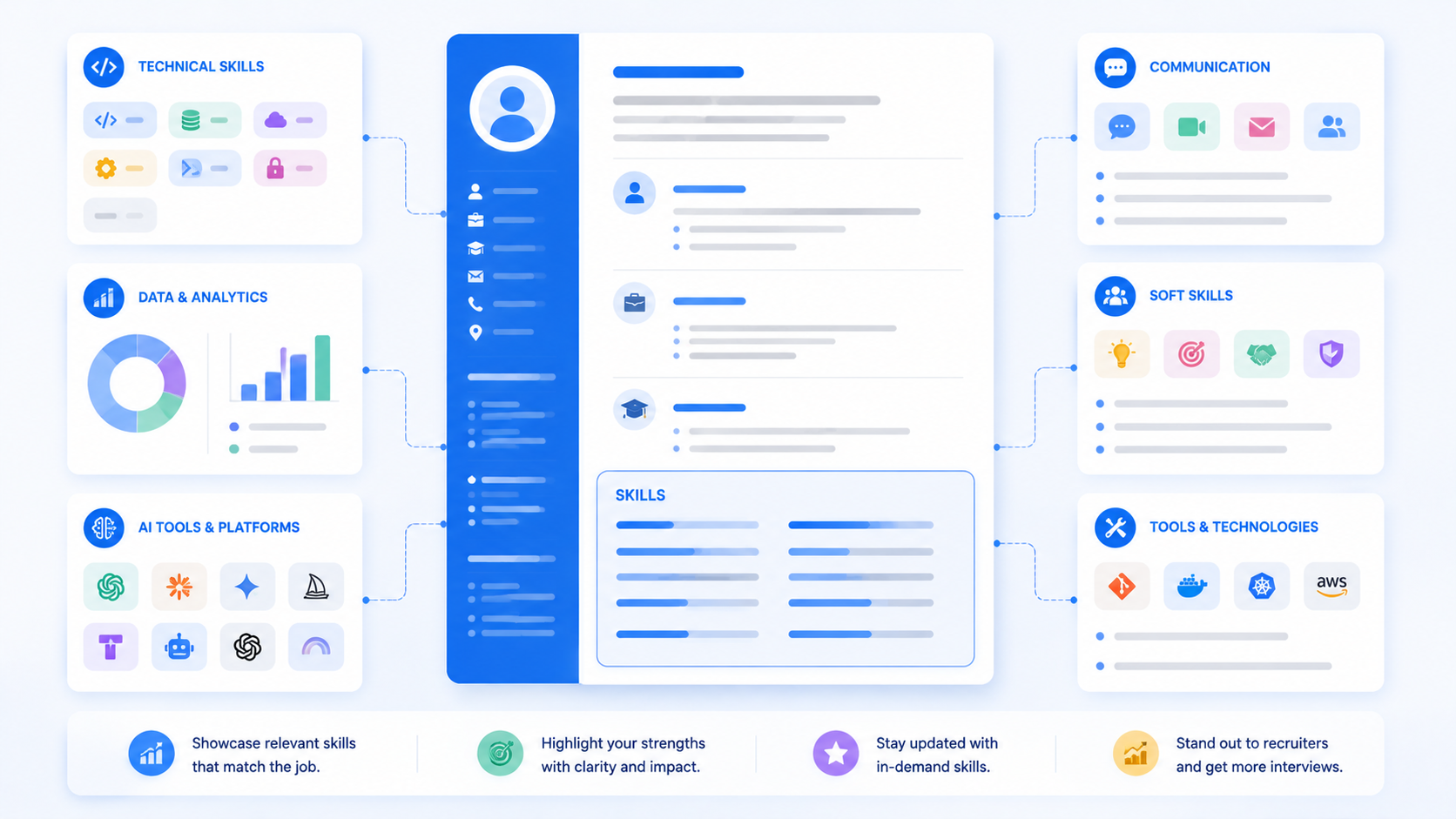
For 2026, the strongest resume skills fall into five groups:
- Role-specific technical skills: the tools, systems, methods, and processes needed for the job.
- AI and digital skills: using AI tools responsibly, working with data, and adapting to new technology.
- Communication skills: writing, presenting, listening, documenting, and explaining ideas clearly.
- Problem-solving skills: analyzing issues, making decisions, improving processes, and handling ambiguity.
- Collaboration and leadership skills: teamwork, ownership, project coordination, coaching, and professionalism.
This matches what major workforce sources are seeing. The NACE Job Outlook 2026 Spring Update reports that employers reviewing entry-level resumes are looking for evidence of teamwork, problem-solving, and communication. The World Economic Forum Future of Jobs Report 2025 points to fast growth in demand for AI, big data, networks, cybersecurity, analytical thinking, resilience, leadership, and collaboration.
The useful takeaway is simple: skills on your resume should show that you can work with modern tools and work well with people.
Technical Skills to List
Technical skills are job-specific abilities. They may include software, equipment, processes, programming languages, industry tools, reporting methods, design tools, financial methods, or compliance knowledge.
Good technical skills for a resume in 2026 may include:
- Microsoft Excel, Google Sheets, pivot tables, formulas, reporting dashboards
- SQL, Python, R, JavaScript, HTML, CSS, Java, C#, PHP
- Salesforce, HubSpot, Zendesk, Shopify, QuickBooks, Jira, Trello, Asana
- Data visualization, Tableau, Power BI, Looker Studio
- Figma, Adobe Photoshop, Illustrator, Canva, UX research
- Cloud basics, AWS, Azure, Google Cloud, Linux, Git, GitHub
- Cybersecurity awareness, access control, incident documentation
- Bookkeeping, accounts payable, accounts receivable, payroll support
- HIPAA awareness, OSHA basics, patient scheduling, medical records
Do not list tools you have only heard of. If you write Salesforce, be ready to explain what you did in Salesforce. If you write SQL, be ready to describe queries, joins, filters, or reports you built.
AI and Digital Skills
AI skills belong on your resume when they are relevant and real. You do not need to claim that you are an AI expert. For many roles, basic AI literacy is enough: knowing how to use tools responsibly, check outputs, speed up routine work, and protect confidential information.
Resume-friendly AI and digital skills include:
- AI-assisted research and drafting
- Prompt writing for business tasks
- AI output review and fact-checking
- Workflow automation
- Data cleaning and analysis
- Digital collaboration tools
- Cybersecurity awareness
- Technology adoption and process documentation
Here is the difference between weak and strong AI wording:
| Weak | Stronger |
|---|---|
| AI tools | Used AI writing tools to draft customer FAQ content, then reviewed outputs for accuracy, tone, and brand fit. |
| ChatGPT | Created structured prompts to summarize research notes and prepare first drafts of internal process documents. |
| Automation | Built a spreadsheet workflow that reduced manual status tracking by consolidating weekly updates in one dashboard. |
The stronger examples show judgment. That matters because employers do not just want people who can click a tool. They want people who can use technology responsibly.
Soft Skills Employers Still Want
Soft skills are still important, but they need proof. Listing "communication" by itself is weaker than showing that you wrote client emails, trained new staff, presented research, created documentation, or handled customer questions.
Strong soft skills to consider in 2026 include:
- Written communication
- Verbal communication
- Teamwork and collaboration
- Problem solving
- Critical thinking
- Adaptability
- Time management
- Leadership
- Customer service
- Conflict resolution
- Attention to detail
- Professionalism
To make these skills stronger, turn them into bullet points:
Trained three new cashiers on register procedures, customer service standards, and daily closing tasks.
Presented weekly inventory updates to the store manager and recommended reorder changes based on sales trends.
Collaborated with a five-person student team to research market data, build slides, and deliver a final business presentation.
These bullets prove teamwork, communication, leadership, and analysis without stuffing the skills section.
Best Skills by Role
Your resume should be tailored to the job. Here are skill examples for common job seeker groups.
College Students and Fresh Graduates
- Research, writing, presentations, teamwork, Excel, Google Workspace, project coordination, customer service, data analysis, leadership
Example bullet: Completed a semester-long market research project using survey results, Excel charts, and team presentations to recommend a campus event strategy.
Administrative Assistant
- Scheduling, calendar management, data entry, records management, Microsoft Office, email communication, travel coordination, invoice support
Example bullet: Managed shared calendars, prepared meeting notes, and organized client records for a six-person office team.
Customer Service
- Customer support, conflict resolution, CRM systems, phone etiquette, live chat, order tracking, product knowledge, problem solving
Example bullet: Resolved customer questions across phone and email while documenting issues accurately in the CRM.
Data Analyst
- SQL, Excel, Python, Tableau, Power BI, data cleaning, dashboards, reporting, statistics, business analysis
Example bullet: Cleaned sales data in Excel and built a Tableau dashboard showing monthly revenue trends by product category.
Software Engineer
- JavaScript, Python, Java, React, Node.js, SQL, Git, APIs, testing, debugging, cloud basics, agile collaboration
Example bullet: Built a React portfolio app with reusable components, API data fetching, form validation, and Git version control.
Marketing
- Content writing, SEO, Google Analytics, social media, email marketing, Canva, campaign reporting, audience research
Example bullet: Created social media posts and tracked engagement metrics to improve weekly content planning.
How to List Skills on a Resume
A good skills section is easy to scan and tailored to the job. Place it near the top of your resume, usually after your summary. If you are a technical candidate, you can group skills by category.
Simple Skills Section
Skills: Customer service, CRM documentation, email support, conflict resolution, order tracking, Microsoft Excel, Google Workspace, data entry
Grouped Skills Section
Technical: SQL, Excel, Tableau, Python
Analysis: Data cleaning, dashboard reporting, trend analysis
Business: Stakeholder communication, documentation, presentation writing
Entry-Level Skills Section
Skills: Research, written communication, Excel, PowerPoint, team projects, customer service, scheduling, data entry, social media content
After the skills section, prove the most important ones in your bullets. If the job asks for Excel, do not only list Excel. Include a bullet that says what you did with it.
How to Choose Skills From a Job Description
Use this quick process:
- Read the job posting once for the overall role.
- Highlight required tools, systems, certifications, and responsibilities.
- Circle repeated words. Repeated words are often important ATS keywords.
- Pick the skills you honestly have.
- Place the most important skills in your skills section and work experience bullets.
Example job posting language:
Must be comfortable using Excel, preparing reports, communicating with customers, tracking orders, and coordinating with internal teams.
Resume skills section:
Skills: Excel reporting, customer communication, order tracking, team coordination, data entry, problem solving
Resume bullet:
Tracked customer orders in Excel, communicated status updates by email, and coordinated with warehouse staff to resolve delivery issues.
This is stronger than dropping keywords into a list without context.
Skills Section Mistakes
Listing Too Many Skills
A long wall of 40 skills looks unfocused. Keep the list tight and relevant.
Using Vague Labels
Words like computer skills, people skills, and office work are too broad. Use specific terms such as Excel, scheduling, customer support, or records management.
Adding Skills You Cannot Prove
If you cannot explain the skill in an interview, do not list it. This is especially important for AI, coding, analytics, and software tools.
Ignoring Soft Skills
Technical skills get attention, but communication, teamwork, professionalism, and problem-solving often decide who gets hired.
Forgetting to Tailor the List
Your skills section should change from job to job. A resume for a marketing coordinator role should not have the same skill order as a resume for an administrative assistant role.
How AICV Create Helps You Pick Resume Skills
AICV Create helps you build an ATS-friendly resume by turning your background and target job into a focused skills section. You can add your experience, projects, education, and job description, then improve your wording so recruiters see the match faster.
It is especially useful if you are unsure whether to list coursework, AI tools, software, certifications, or transferable skills. AICV Create helps organize your strongest skills into a clean resume and download a polished PDF.
FAQ
What are the best skills to put on a resume in 2026?
The best skills include role-specific technical skills, AI literacy, data analysis, communication, teamwork, problem-solving, adaptability, leadership, project coordination, and customer focus.
How many skills should I list on my resume?
Most resumes should list 8 to 15 highly relevant skills. More than that can look unfocused unless you are in a technical field and group them clearly.
Should I include AI skills on my resume?
Yes, if they are relevant and real. Mention how you used AI tools, not just the tool name.
Are soft skills important on a resume?
Yes. Employers still value communication, teamwork, problem-solving, professionalism, and adaptability. Support them with examples.
Where should skills go on a resume?
Place a skills section near the top, usually after your resume summary. Then prove key skills in your experience, projects, or education sections.
What skills should students put on a resume?
Students can list coursework-related skills, research, writing, presentations, Excel, team projects, customer service, leadership, internships, volunteer work, and technical tools.
Can AICV Create help choose resume skills?
Yes. AICV Create can help compare your background to a job description and suggest stronger ATS-friendly skills and bullets.
Conclusion
The best skills to put on a resume in 2026 are specific, truthful, and connected to the job you want. Use the job description as your guide, include modern technical and AI-related skills when relevant, and do not forget the human skills employers still depend on: communication, teamwork, problem-solving, adaptability, and leadership.
If you want help choosing the right skills and proving them with stronger bullets, build your resume with AICV Create. It helps you create an ATS-friendly resume, tailor your wording to job descriptions, and download a professional PDF for applications.