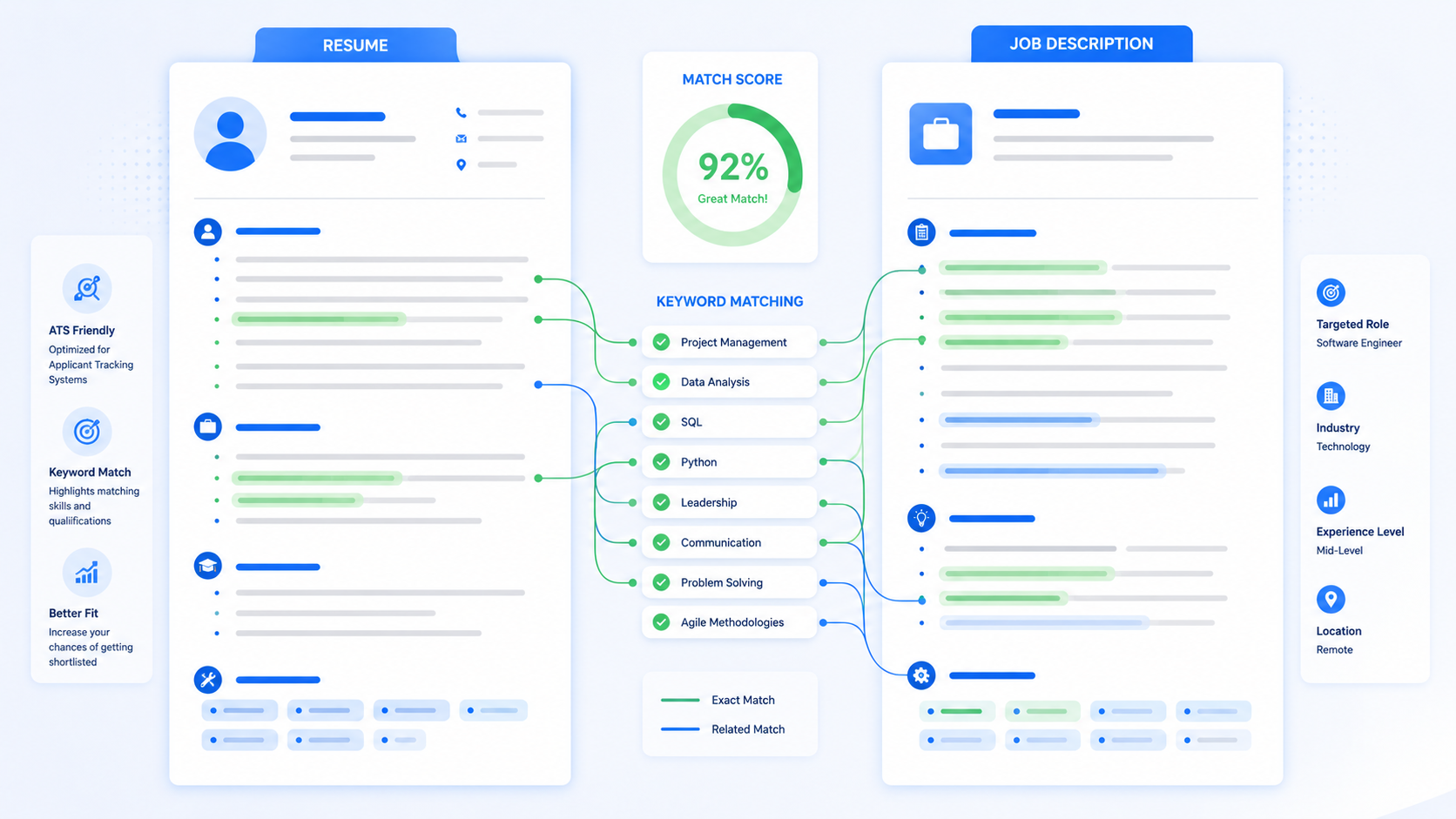
Most job seekers either send the same resume everywhere or spend an hour rewriting it for every posting — and both habits cost interviews. Learning how to tailor resume to job description content quickly, without starting from scratch each time, is what actually lets you apply to more jobs without burning out.
This guide covers a fast, repeatable system for tailoring: what to change, what to leave alone, and how to customize resume content in minutes instead of hours. You'll also see a real before-and-after example of the system in action.
TL;DR
- Build one detailed master resume with everything you might ever use.
- Only edit your summary, skills section, and top two bullet points per job.
- Set a 15-minute time limit to avoid over-polishing sections that don't need it.
- Keep a bank of pre-written swap lines to reuse across similar jobs.
- Save each version with a clear file name and do a two-minute final check.
Table of Contents
Why Tailoring a Resume Usually Takes Too Long
Most advice on this topic focuses on finding keywords, which is useful but only half the problem. The real bottleneck is speed — rewriting a whole resume for every job isn't sustainable if you're applying to more than a few roles a week.
Think of a fully rewritten resume like cooking a meal from scratch every single night. It's doable once. It's exhausting by day five. A better system reuses a solid base and swaps only what needs to change.
Job seekers who tailor a resume slowly usually run into:
- Rewriting sections that didn't actually need to change
- Losing track of which version was sent where
- Burning out after a handful of applications
- Second-guessing wording instead of following a repeatable process
The fix isn't skipping tailoring. It's building a system that makes it fast enough to do every time.
Most guides on how to tailor resume to job description content focus entirely on finding the right keywords. That part matters, but it assumes you have unlimited time to rebuild your resume from scratch for every posting.
Once you have a working system, you can tailor resume to job description content for almost any role in about the time it takes to read the posting twice.
If you haven't built a fully keyword-matched resume yet, start with the full guide to matching keywords first, then come back to this system to speed up every version after that.
This guide assumes the opposite: you're applying to multiple jobs a week and need a process that holds up under that pace, not just a one-time deep edit.
None of this means the deep, keyword-focused approach is wrong. It's the right method the first time you build a strong tailored resume for a given role. This system just makes every version after that one much faster to produce.
How to Build a Fast Resume Tailoring System, Step by Step
This system is built around one master resume and a small set of "swap zones" you update for each job. Once it's set up, you can tailor resume to job description requirements for a new posting in a fraction of the usual time.
Step 1: Build One Detailed Master Resume
Write a single resume with every job, project, skill, and bullet point you might ever use — longer than any one application needs. This becomes the source you trim from, not the version you send.
Think of this as your raw material. You'll never send the master version as-is, but having everything in one place means you're never starting from a blank page when you tailor a resume for a new posting.
Step 2: Identify Your Three Swap Zones
Focus your edits on the summary, the skills section, and the top two bullet points under your most recent role. These three spots do most of the work in matching a job description.
Everything else on the page — education, older roles, certifications — rarely needs to change between applications. Leaving those alone is what makes this whole system fast.
If you're unsure which two bullet points matter most, pick the ones closest to the job posting's top requirements, not necessarily your most recent tasks.
| Full Rewrite (Slow) | Swap Zone System (Fast) |
|---|---|
| Rewriting every bullet point for each job | Editing only the summary, skills, and top two bullets |
| 45-60 minutes per application | 10-15 minutes per application |
| No consistent structure between versions | Same base resume, small targeted swaps |
Free tools like AICV Create handle this automatically — you keep one profile of your experience, and its AI suggestions help you customize resume sections for each job without rebuilding the whole document.
Step 3: Set a Time Limit Before You Start Editing
Give yourself 15 minutes per application and stick to it. A hard limit stops you from over-polishing a bullet point that was already good enough.
A timer sounds simple, but it changes how you edit. Instead of chasing a perfect sentence, you're making the highest-impact change available in the time you have.
Step 4: Keep a Bank of Pre-Written Swap Lines
Save two or three phrasings for your most common skills and achievements, so you're choosing between options instead of writing from nothing each time.
Over a few weeks of applying, this bank grows into a genuinely useful shortcut. You'll often find that a phrase you wrote for one job works with almost no changes for the next similar one.
Step 5: Save Each Version With a Clear File Name
Name every tailored resume with the company and role, like "Resume-Acme-MarketingCoordinator.pdf." This avoids sending the wrong version by mistake.
Step 6: Do a Two-Minute Final Check Before Sending
Scan for the wrong company name, a leftover phrase from a different job, or a skill that no longer fits. This last check catches the kind of mistake that a fast system can otherwise let slip through.
Common Mistakes People Make When Tailoring a Resume
- Rewriting the entire resume every time. Most of the document doesn't need to change — this wastes time you could spend applying to more roles.
- Skipping tailoring entirely to save time. A completely generic resume usually scores lower with both recruiters and applicant tracking systems.
- Losing track of which version went where. Sending the wrong tailored resume to the wrong company looks careless and is easy to avoid with clear file names.
- Obsessing over a single bullet point. Perfecting one line for twenty minutes isn't worth it if it means applying to two fewer jobs that week.
- Forgetting to update the skills section. Many people tailor the summary and forget the skills list, which recruiters and scanners check just as closely.
- Not having a master resume to work from. Starting from the last tailored version instead of a full master copy means details slowly get lost between applications.
Most of these mistakes come from treating tailoring as an all-or-nothing task instead of a quick, structured routine. Fixing even two or three of them makes the whole process faster and more reliable.
Pro Tips for Tailoring a Resume Faster
- Batch similar applications together. Tailoring three marketing coordinator postings back-to-back is faster than switching between different job types all day.
- Highlight the job posting before you touch your resume. Mark the three or four requirements that repeat most, and only tailor around those.
- Reuse your best-performing tailored version as a new template. If a version led to an interview, it's probably close to right for similar roles.
- Don't tailor what doesn't need it. Education, certifications, and older roles rarely need changes between applications.
- Track which tailored version gets responses. If a certain summary or bullet phrasing consistently leads to callbacks, treat it as your new default starting point.
★ PRO TIP: Keep a running "swap bank" document with three versions each of your summary and top bullet points, written for different job types. Tailoring becomes picking the closest match and adjusting a few words, not writing from zero.
Before your final version goes out, double-check it against the full ATS resume format checklist to make sure formatting stays consistent.
AICV Create's AI writing suggestions can generate a few tailored phrasings on the spot, which speeds up exactly this kind of quick-swap editing.
Real Example: A Faster Tailoring System in Action
Ben was spending close to an hour tailoring his resume for each marketing role, which meant he could only realistically apply to four or five jobs a week.
He built one detailed master resume, then limited his edits to his summary, skills section, and top two bullet points for each posting, using a 15-minute timer. For the skills section specifically, he leaned on how to format your resume skills section to keep that part consistent across versions.
Within two weeks, he was applying to 12-15 jobs a week instead of four, without any drop in match quality. He landed more interviews simply because he was applying to more roles with a resume that was still genuinely tailored.
He also noticed his swap bank getting stronger each week. By his tenth application, most of his edits were picking between two pre-written options rather than writing anything new.
Ben's case shows the real trade-off clearly. A slightly less exhaustive edit on each resume, applied to three times as many jobs, beat one perfectly polished resume sent to a handful of postings.
Build Your Resume Free with AICV Create
A fast tailoring system works even better with a tool built to support it. AICV Create keeps your full profile ready so you can tailor resume to job description requirements and customize resume sections for each job in minutes.
- ATS-friendly templates that keep your base resume consistent
- AI writing suggestions for quick, tailored phrasing
- Instant PDF download, free to start, no design skills needed
→ Create your free resume at aicvcreate.com — no account needed to get started.
FAQ
What does it mean to tailor a resume to a job description?
Tailoring means adjusting your summary, skills, and top bullet points to match a specific job's requirements, without rewriting your whole resume. It's about presenting your real experience in the most relevant order and language.
How do I tailor my resume to a job description quickly?
Build one detailed master resume, then only edit your summary, skills section, and top two bullet points for each posting. Set a 15-minute time limit to avoid over-editing sections that don't need it.
Is it necessary to customize resume content for every job?
Yes, for most roles. A resume tailored even lightly to the job description usually performs better than a fully generic one, since it matches both recruiter expectations and applicant tracking system scans.
How long should tailoring a resume take?
With a master resume and a clear system, most tailoring takes 10-15 minutes per application. A full rewrite from scratch can take 45 minutes or more, which isn't sustainable for regular job searching.
Is aicvcreate.com really free?
Yes. AICV Create is free to use with core features including resume editing, ATS-friendly templates, and PDF export. Pro plans unlock unlimited resumes, AI writing, and advanced tools — but you can build and download a complete resume without paying anything.