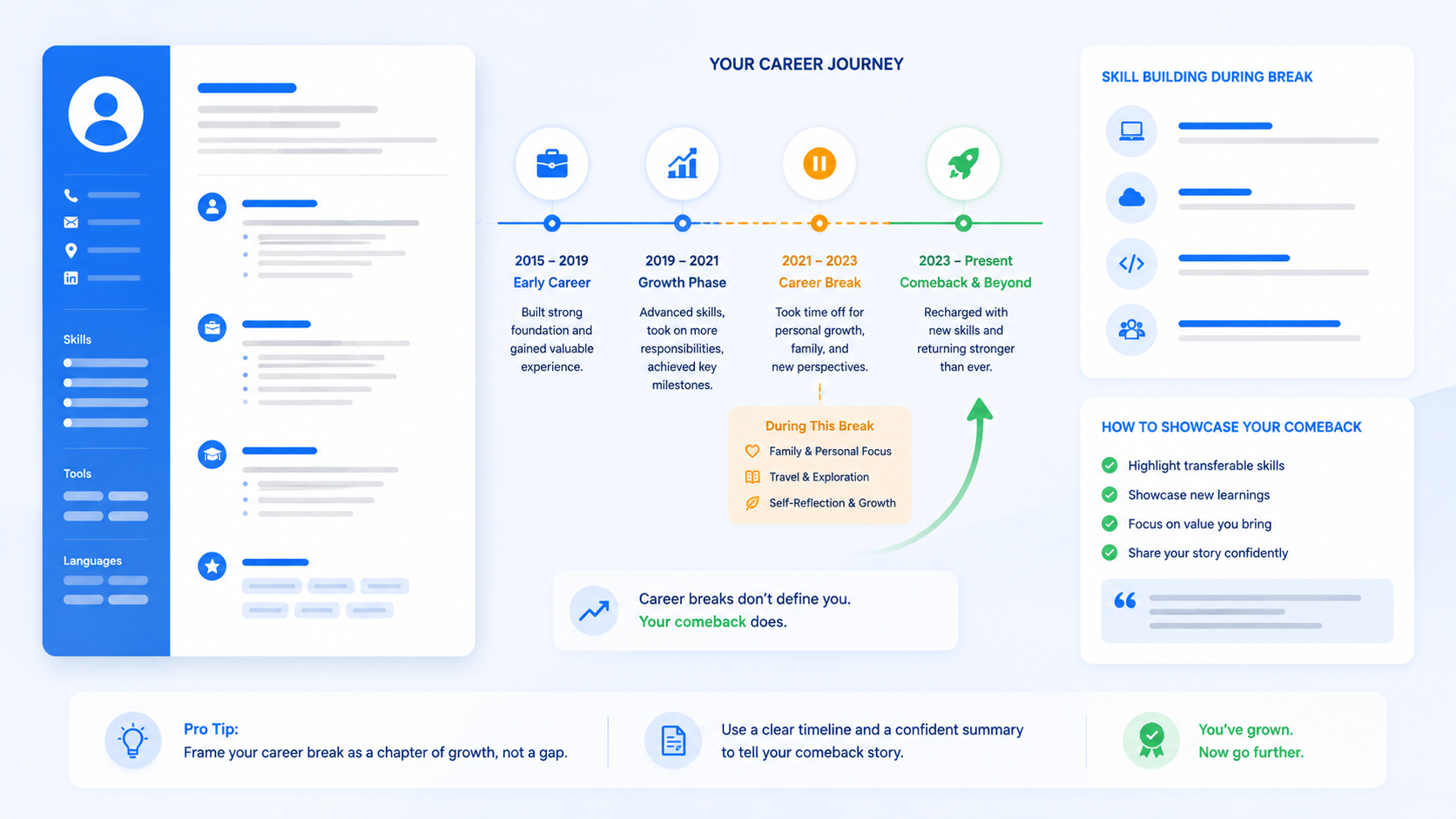
TL;DR
- Do not panic about a resume gap. Many people have time away from work because of layoffs, caregiving, school, health, relocation, parenting, or career changes.
- Explain the gap only as much as needed. One clear line is often enough.
- Use a career break entry when the gap is long, recent, or visually obvious in your work history.
- Show what you did during the gap if it is relevant: training, certifications, freelance work, volunteering, projects, or job-search preparation.
- Keep private details private. You can be truthful without sharing medical, family, or personal information.
- Use AICV Create to turn your career break into clean, ATS-friendly resume wording.
Table of Contents
Why Employment Gaps Matter
An employment gap is a period when you were not formally employed. It might be a few months between jobs or several years away from the workforce. A gap does not automatically make you a weak candidate, but it can raise questions if your resume timeline is unclear.
Recruiters often review resumes quickly. If they see missing dates without context, they may wonder whether you were laid off, caring for family, recovering from illness, relocating, studying, freelancing, or simply left something out. Your goal is not to tell your whole life story. Your goal is to remove uncertainty and refocus the reader on your qualifications.
Career guidance from Indeed recommends addressing gaps clearly and keeping your explanation aligned across your resume, cover letter, and interview. That is good advice because inconsistent explanations can create doubt even when the gap itself is reasonable.
There is also a practical upside. SHRM has reported on research showing that applicants who explained a work gap with additional training or education received stronger callback results than those who left the reason unclear. The lesson is not that every gap must involve school. The lesson is that context helps.
When to Explain a Gap on Your Resume
You do not need to explain every short break. A one- or two-month gap between jobs is common. Recruiters understand that hiring takes time. You should consider explaining a gap when:
- It lasted six months or longer.
- It is your most recent timeline entry.
- It happened more than once and may look like a pattern.
- You used the time for training, caregiving, freelance work, relocation, or other meaningful activity.
- The gap would be obvious even if you use years instead of months.
For older gaps, you may not need much detail. If you have had several years of steady work since the break, your recent experience matters more. Keep your resume focused on the last 10 to 15 years unless older experience is highly relevant.
Where to Put an Employment Gap
Option 1: Add a Career Break Entry
This is the clearest option for a long or recent gap. Treat it like a simple resume entry, but keep it short.
Career Break | March 2024 - January 2025
Focused on family caregiving while completing Google Data Analytics coursework and maintaining Excel, SQL, and Tableau practice projects.
This removes the mystery and adds relevant activity without overexplaining.
Option 2: Explain It in Your Summary
If you are returning to work after a break, your resume summary can frame the transition.
Administrative professional returning to the workforce after a family caregiving break, with prior experience in scheduling, customer communication, records management, and Microsoft Office. Recently refreshed Excel and Google Workspace skills through online coursework.
Option 3: Use a Cover Letter
If the gap is personal and you do not want it on the resume, use one short sentence in your cover letter. This works well for health, caregiving, relocation, or a career pause.
After taking a planned career break for family caregiving, I am ready to return to full-time administrative work and bring strong scheduling, documentation, and client communication experience to your team.
Option 4: Use Years Instead of Months
If your gaps are small, using years can make the timeline cleaner:
Marketing Coordinator | 2022 - 2024
Marketing Assistant | 2020 - 2022
Do not use this to hide a major gap. Use it when the month-by-month detail adds noise without helping the reader.
Employment Gap Resume Examples
Here are practical examples you can adapt. The right wording depends on the reason for the gap and the job you want now.
Layoff Gap
Career Transition | June 2025 - Present
Pursuing customer success and account support roles after company restructuring. Completed CRM refresher training, updated Salesforce skills, and built a portfolio of customer onboarding process examples.
Why it works: it names the situation without blame and points to current preparation.
Caregiving Gap
Family Caregiving Break | 2023 - 2025
Took time away from full-time work for family caregiving. Maintained professional skills through Excel practice, online business writing coursework, and volunteer coordination for a local nonprofit.
Why it works: it gives context and keeps private details out.
Health-Related Gap
Career Break | 2024
Took a personal health leave and am now ready to return to full-time work. Refreshed project management and Microsoft Office skills through online coursework.
Why it works: it is honest but does not disclose medical details.
Parenting Gap
Parental Leave and Career Break | 2021 - 2024
Stepped away from full-time work for parenting responsibilities. Continued professional development through bookkeeping coursework, QuickBooks practice, and part-time volunteer treasurer duties.
Why it works: it connects the break to relevant accounting and administrative skills.
School or Training Gap
Professional Development | August 2024 - May 2025
Completed a web development certificate covering JavaScript, React, Git, responsive design, and API basics. Built three portfolio projects and contributed code updates through GitHub.
Why it works: training gaps can be strengths when they connect directly to the target role.
Relocation Gap
Relocation and Job Search | September 2025 - January 2026
Relocated to Austin, Texas and prepared for local opportunities in operations support. Updated Excel, scheduling, and inventory tracking skills while researching regional employers.
Why it works: relocation is common, and this wording shows the candidate stayed focused.
Freelance or Contract Work During a Gap
Freelance Design Projects | 2024 - 2025
Created social media graphics, landing page mockups, and brand templates for small business clients using Canva, Figma, and Adobe Photoshop. Managed client communication, deadlines, and file delivery.
Why it works: freelance work is work. If you completed real projects, list them clearly.
What If You Did Nothing Career-Related During the Gap?
That is still workable. You do not need to invent activity. Use a simple explanation and make the rest of the resume strong.
Career Break | 2024 - 2025
Took time away from work for personal reasons and am now ready to return to full-time customer service roles.
Then strengthen your summary, skills section, and previous experience. If you can start a short course, volunteer project, portfolio piece, or certification now, do it. Recent action helps employers see momentum.
The U.S. Bureau of Labor Statistics points job seekers toward research, resumes, interviews, and job-search planning. Even a short period spent updating your resume, learning job requirements, and practicing interviews can help you talk about your return with more confidence.
What to Say in a Cover Letter
Your cover letter should not spend half the page defending the gap. One or two sentences is enough. Then move to why you fit the job.
Example for Caregiving
After taking time away from work for family caregiving, I am ready to return to a full-time administrative role. My previous experience in scheduling, customer communication, and records management aligns well with your office coordinator opening.
Example for Layoff
My previous role ended after a company restructuring, and I have used the transition period to update my CRM and reporting skills. I am especially interested in your customer success associate role because it matches my experience supporting accounts and resolving client questions.
Example for Career Change
I took a planned career break to complete data analytics training and build a portfolio of SQL, Excel, and Tableau projects. I am now looking for an entry-level analyst role where I can combine my prior operations experience with new technical skills.
How to Explain Gaps in an Interview
Use a three-part answer:
- State the reason briefly.
- Explain what you did to stay prepared, if relevant.
- Redirect to the role and your readiness.
Example:
I took a career break in 2024 for family caregiving. During that time, I kept my Excel and administrative skills current through online coursework and volunteer scheduling work. I am ready to return full time, and this role is a strong match because it uses the coordination, records, and customer communication experience I built in my last position.
Practice this answer out loud. You want it to sound calm, not rehearsed like a speech. Do not overexplain. If the interviewer asks a follow-up, answer briefly and bring the conversation back to your qualifications.
Mistakes to Avoid
Leaving a Major Gap Completely Unexplained
If the gap is obvious, silence can create more questions than a short explanation would.
Sharing Too Much Personal Detail
You do not need to discuss diagnoses, family issues, finances, or private circumstances. Use neutral labels like personal leave, family caregiving, parental leave, relocation, or career break.
Apologizing for the Gap
A resume gap is part of your timeline, not a confession. Keep the tone professional and confident.
Using a Functional Resume to Hide Dates
A purely functional resume can make recruiters suspicious because it separates skills from work history. A reverse-chronological resume with a short gap explanation is usually cleaner.
Forgetting ATS Keywords
Even with a gap, your resume still needs relevant job titles, skills, tools, certifications, and industry terms. Match your wording to the job description when it is truthful.
How AICV Create Can Help
AICV Create helps job seekers write clear, ATS-friendly resumes without making career gaps awkward. You can add your work history, explain a break in simple language, and build stronger resume summaries, skills sections, and bullet points around what you can offer now.
If you are returning after a layoff, caregiving period, health leave, relocation, parenting break, or career change, AICV Create can help you choose professional wording and download a polished PDF for applications.
FAQ
Should I put an employment gap on my resume?
If the gap is recent or long enough to make your timeline unclear, address it briefly. Short gaps of a few months usually do not need a separate entry.
How do I explain a career gap professionally?
Use a short, honest explanation, then redirect attention to your skills, training, projects, volunteer work, or readiness for the role.
What is the best resume format for employment gaps?
A reverse-chronological resume with a brief career break entry usually works best. You can also add a strong skills section near the top.
Can I say I took time off for personal reasons?
Yes. You can say personal leave, family caregiving, health leave, relocation, education, or career break without sharing private details.
Will an ATS reject my resume because of an employment gap?
An ATS usually parses dates and keywords, but hiring decisions are made by people. Clear formatting and relevant keywords help.
Should I mention a layoff on my resume?
You can mention company restructuring or role elimination if it explains a recent gap. Keep it brief and focus on your next role.
Can AICV Create help explain a resume gap?
Yes. AICV Create can help write a concise career break entry, update your summary, and create an ATS-friendly resume.
Conclusion
Employment gaps are not rare, and they do not have to define your application. The key is to remove confusion without overexplaining. Use a short, honest label, add relevant training or activity when you have it, and keep the rest of your resume focused on skills, achievements, and fit for the job.
When you are ready to apply, build your resume with AICV Create. It helps you write professional gap explanations, tailor your summary, improve your bullet points, and export an ATS-friendly PDF with confidence.