TL;DR
- A resume summary is a short opening section that explains what you can do for the employer.
- Beginners should focus on education, projects, internships, volunteer work, certifications, tools, and transferable skills.
- Keep your summary specific to the job. Mention the target role, relevant skills, and one or two pieces of evidence.
- Use simple language. Avoid phrases like "hard-working professional" unless you prove them with facts.
- A strong beginner summary is usually 40 to 70 words and sits directly below your name and contact information.
Table of Contents
What Is a Resume Summary?
A resume summary is a short paragraph at the top of your resume that introduces your most relevant qualifications. It helps a recruiter understand your fit before they read the rest of the page.
For beginners, the resume summary is not a place to apologize for limited experience. It is a place to connect your background to the job. If you are a college student, recent graduate, career changer, or someone applying for a first office job, your summary can highlight what you have already done through school, projects, part-time work, internships, volunteer roles, or training.
The best beginner resume summaries answer three questions quickly:
- What role or field are you targeting?
- Which skills match the job?
- What evidence shows you can use those skills?
That evidence matters. Employers do not need a dramatic personal statement. They need a reason to keep reading. A summary that says you are "motivated" is weaker than one that says you completed a data analysis project, supported 30 customers per shift, maintained a 3.7 GPA, or built a portfolio website.
The National Association of Colleges and Employers defines career readiness through competencies such as communication, critical thinking, teamwork, professionalism, technology, and leadership. Those are useful categories for beginners because many of them can be proven outside full-time work.
Resume Summary vs. Resume Objective
A resume objective tells the employer what you want. A resume summary tells the employer what you offer.
Older resume advice often told beginners to write an objective like this:
Seeking an entry-level marketing role where I can grow my skills and contribute to a successful company.
That sentence is polite, but it does not say much. Most applicants want to grow. A stronger version gives the employer useful information:
Entry-level marketing graduate with coursework in digital analytics, social media strategy, and consumer behavior. Created a campaign plan for a campus organization that increased event sign-ups by 22% and comfortable using Canva, Google Analytics, and Excel.
The second version still shows career direction, but it also gives skills, tools, and proof. That is why a summary is usually better for beginners.
When a Resume Objective Can Still Work
An objective can help if you are making a career shift and your resume might otherwise confuse the reader. For example, a retail associate applying for an administrative assistant role can use one sentence to explain the shift, then support it with transferable skills.
Even then, combine objective and summary language:
Customer service professional moving into administrative support, with three years of experience managing schedules, handling customer records, processing payments, and resolving problems in a fast-paced retail setting.
This works because it does not only say what the candidate wants. It also explains why the move makes sense.
A Simple Formula for Beginners
You do not need to make your resume summary complicated. Use this formula:
- Start with your target identity: student, recent graduate, entry-level candidate, career changer, or job title.
- Add two to four relevant skills from the job description.
- Include proof from school, projects, internships, volunteer work, certifications, or part-time jobs.
- End with the value you can bring to the role.
Here is the structure in one sentence:
[Target role or background] with experience in [skill 1], [skill 2], and [skill 3], shown through [project, internship, job, volunteer work, or achievement]. Interested in supporting [type of team or business outcome].
Example:
Entry-level administrative assistant with experience in scheduling, customer communication, Excel, and document organization through campus office work and retail customer service. Known for accurate records, calm problem solving, and reliable follow-through in busy environments.
Notice the summary does not pretend the person has ten years of experience. It uses honest evidence and connects it to the job.
Resume Summary Examples for Beginners
Use these beginner resume summary examples as models. Do not copy them word for word. Replace the details with your own skills, tools, numbers, and projects.
1. Student With No Paid Work Experience
College sophomore pursuing a business administration degree with strong coursework in accounting, business communication, and data analysis. Completed team projects using Excel and PowerPoint to research customer trends, build presentations, and recommend process improvements. Seeking an internship where organization, research, and communication skills can support daily business operations.
Why it works: it uses coursework and team projects as proof. It also names tools and the kind of work the student can support.
2. Recent Graduate
Recent psychology graduate with research, writing, and client-facing experience gained through academic projects, peer mentoring, and volunteer work. Skilled in interviewing, organizing information, writing reports, and presenting findings clearly. Interested in entry-level human services or recruiting roles that require empathy, accuracy, and strong communication.
Why it works: it translates a degree into workplace skills without overclaiming.
3. Entry-Level Customer Service
Entry-level customer service candidate with experience assisting guests, handling payments, answering questions, and solving routine issues through part-time retail and campus event roles. Strong communicator who stays calm under pressure and learns new systems quickly. Ready to support customers with accurate information and friendly service.
Why it works: it keeps the language direct and job-related. Customer service roles value communication, accuracy, and patience.
4. College Student Applying for an Internship
Junior finance student with coursework in financial accounting, business statistics, and investment analysis. Built Excel models for class projects, prepared research summaries, and presented recommendations to student teams. Looking for a finance internship where analytical thinking, spreadsheet skills, and attention to detail can support reporting and planning tasks.
Why it works: it names the field, relevant coursework, and tools. It also shows the student understands internship-level work.
5. Career Changer
Former hospitality team lead transitioning into office administration, with four years of experience coordinating schedules, training new staff, resolving customer issues, and maintaining accurate daily records. Comfortable with Microsoft Office, point-of-sale systems, and written communication. Brings strong organization, service mindset, and follow-through to administrative support roles.
Why it works: it connects past work to future work. A recruiter can see why the candidate may fit an administrative role.
6. Beginner Software Developer
Entry-level software developer with hands-on experience building web projects using JavaScript, HTML, CSS, React, and Git. Completed a portfolio project that stores user data, validates forms, and displays responsive dashboards. Interested in junior front-end roles where clean code, problem solving, and continuous learning are valued.
Why it works: it lists real tools and gives a project example. For technical roles, a summary should point to proof quickly.
7. Entry-Level Data Analyst
Entry-level data analyst with experience using Excel, SQL, and Tableau through coursework and independent projects. Analyzed sales and survey datasets, cleaned raw data, created dashboards, and summarized findings for nontechnical audiences. Strong interest in using data to improve business decisions and reporting accuracy.
Why it works: it highlights the workflow: clean data, analyze it, visualize it, and explain it.
8. Beginner Healthcare Resume Summary
Certified nursing assistant candidate with clinical training in patient care, vital signs, infection control, and documentation. Known for dependable attendance, respectful communication, and careful attention to patient comfort. Seeking an entry-level healthcare role supporting safe, compassionate care in a clinic, hospital, or long-term care setting.
Why it works: it includes training, care standards, and the work setting. Healthcare employers value reliability and patient safety.
How to Write a Resume Summary With No Experience
If you have no formal work experience, do not leave the top of your resume empty. Use evidence from other parts of your life. Employers hiring beginners know you may not have a long work history. They still want to see readiness.
The U.S. Bureau of Labor Statistics recommends using job-search resources to explore occupations and prepare application materials. For beginners, that research matters because your summary should match the type of role you are applying for, not just describe you in general.
Step 1: Choose a Target Role
Do not write one summary for every job. A summary for a customer service role should look different from a summary for a data analyst internship.
Before writing, choose one target:
- Marketing intern
- Administrative assistant
- Junior web developer
- Retail associate
- Data analyst intern
- Teacher assistant
If you are applying to different job types, create different resume versions.
Step 2: Pull Keywords From the Job Description
Look for repeated skills, tools, and responsibilities. If a job posting mentions scheduling, customer communication, Excel, and records, your summary should include the skills you genuinely have in those areas.
Do not stuff keywords into the paragraph. Use the most important ones naturally.
Step 3: Find Proof From Your Background
Beginners often have more proof than they think. Look at:
- Coursework and capstone projects
- Volunteer roles
- Campus clubs and student leadership
- Part-time jobs
- Freelance projects
- Certifications and online training
- Portfolio work
- Sports, military service, or community programs
Then translate that experience into employer language. "Helped at school events" can become "coordinated check-in, answered attendee questions, and tracked registrations for campus events."
Step 4: Add One Measurable Detail if Possible
Numbers make beginner summaries stronger, but only use real numbers. Good examples include:
- Supported 20+ customers per shift
- Maintained a 3.8 GPA
- Created five portfolio projects
- Trained three new volunteers
- Prepared weekly reports for a student organization
If you do not have numbers, use specific nouns: tools, project types, audiences, industries, or outcomes.
Before-and-After Beginner Summary Examples
The fastest way to improve a weak summary is to replace vague adjectives with specific evidence.
| Weak summary | Stronger summary |
|---|---|
| Hard-working student looking for a job where I can learn and grow. | Business student with coursework in Excel, customer communication, and operations. Supported campus events by organizing check-in, answering questions, and tracking attendee details. |
| Recent graduate with good communication skills and a positive attitude. | Recent communications graduate with experience writing reports, presenting research, editing web content, and coordinating student organization updates for campus audiences. |
| Entry-level IT worker seeking an opportunity. | Entry-level IT support candidate with CompTIA A+ training, troubleshooting practice, and experience helping users resolve hardware, software, and account access issues in a lab environment. |
The stronger versions are not longer because they are fancy. They are stronger because they are clearer.
Common Beginner Resume Summary Mistakes
Writing Too Much About What You Want
It is fine to have career goals, but your resume summary should focus on employer needs. Replace "I want to gain experience" with what you can already help with.
Using Vague Soft Skills
Words like dependable, passionate, and team player are weak without proof. If you want to show teamwork, mention a team project, volunteer event, or group result.
Making the Summary Too Long
A beginner summary should not become a cover letter. Keep it short enough that a recruiter can scan it in a few seconds.
Adding Skills You Cannot Explain
Only list tools and skills you can talk about in an interview. If you mention SQL, be ready to explain what you used it for.
Using the Same Summary for Every Job
A generic summary weakens your resume. Adjust the top section for each role so the first lines match the job posting.
How AICV Create Helps Beginners Write Better Summaries
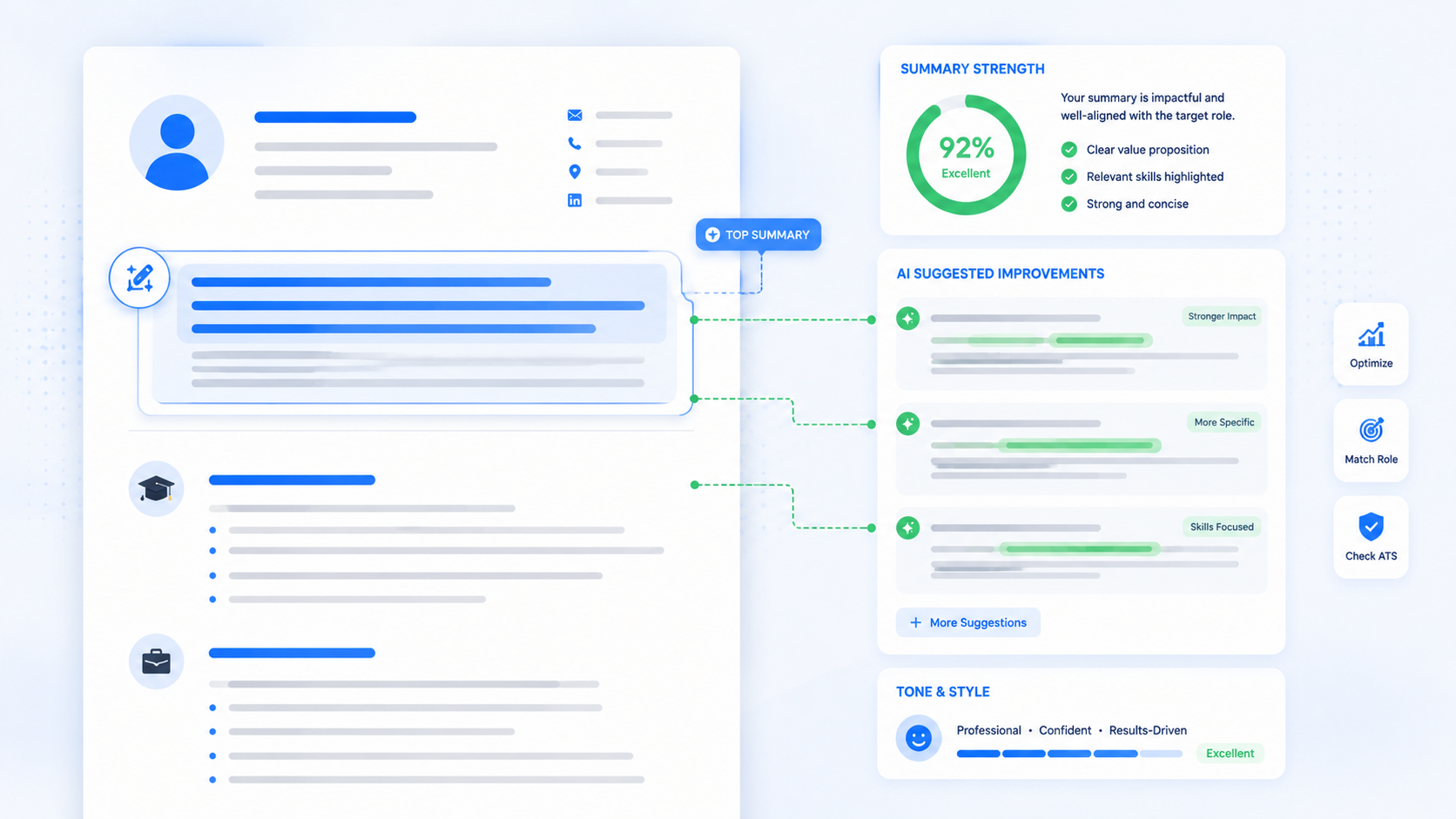
AICV Create helps you turn scattered experience into a clean, job-focused resume. You can start with your education, projects, volunteer work, or part-time jobs, then use AI-powered suggestions to create a stronger summary and ATS-friendly resume structure.
For beginners, this is especially useful because the hardest part is often wording. You may know what you did, but not how to say it in resume language. AICV Create helps convert plain notes into polished summaries, skills, bullets, and downloadable PDFs without making your resume sound inflated.
FAQ
What is a resume summary for beginners?
It is a short opening paragraph that highlights your target role, strongest skills, and proof from school, projects, volunteer work, internships, certifications, or part-time jobs.
How long should an entry-level resume summary be?
Two to four lines is enough for most beginners. Aim for about 40 to 70 words.
Should beginners use a resume objective or summary?
A summary is usually stronger because it shows what you offer. If you use an objective, include relevant skills and evidence.
Can I write a resume summary with no work experience?
Yes. Use coursework, academic projects, campus leadership, volunteer work, certifications, and technical skills.
Should my resume summary include soft skills?
Yes, but only when you support them. Instead of saying "good communicator," mention presentations, customer service, tutoring, reports, or team projects.
Do ATS systems read resume summaries?
Many applicant tracking systems parse resume text, including summaries. Use clear wording and relevant keywords from the job description.
Can AICV Create write my resume summary?
Yes. AICV Create can help build a tailored resume summary using your background and the role you want.
Conclusion
A beginner resume summary does not need years of experience to be effective. It needs focus, proof, and language that matches the job. Start with the role you want, choose the skills the employer cares about, and support those skills with honest examples from school, projects, volunteer work, training, or part-time jobs.
If you want a faster way to shape your first draft, try AICV Create. It helps you build an ATS-friendly resume, write a clearer summary, improve your bullet points, and download a polished PDF for your next application.